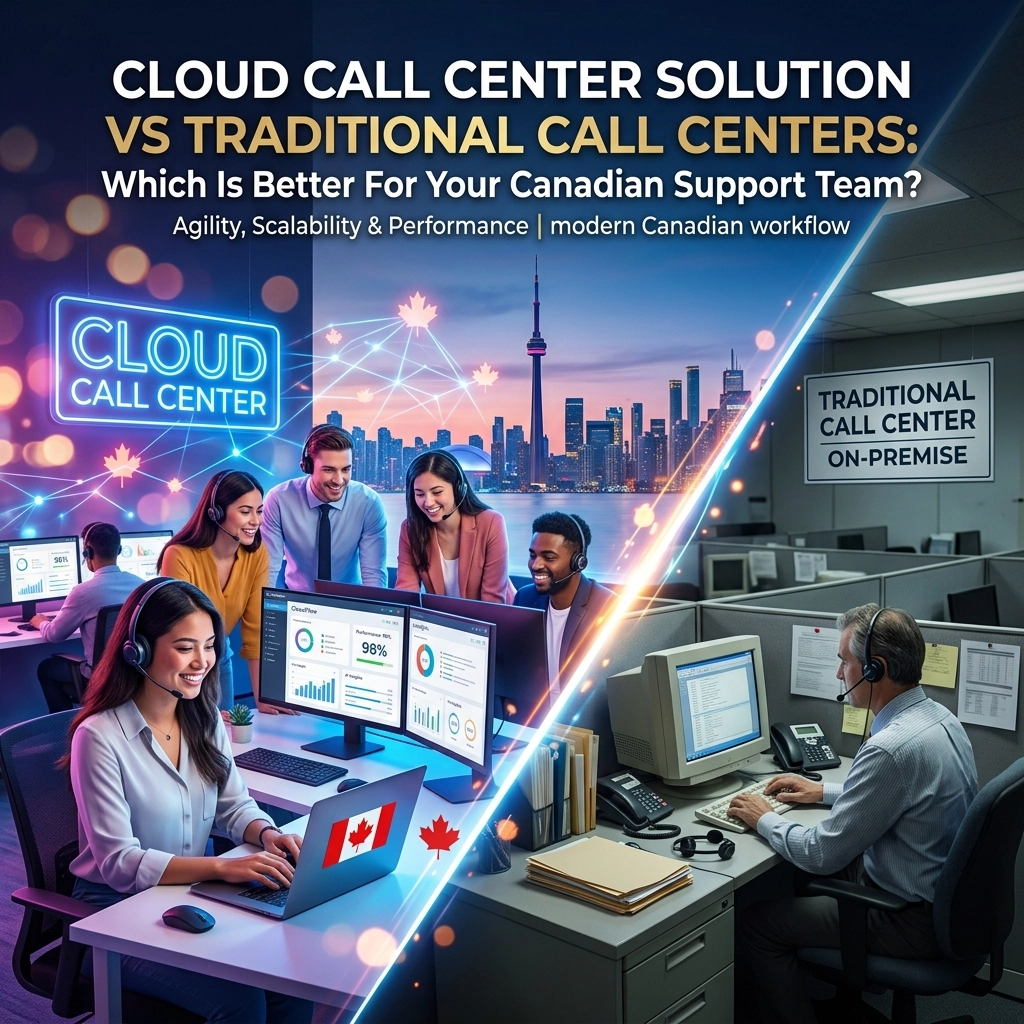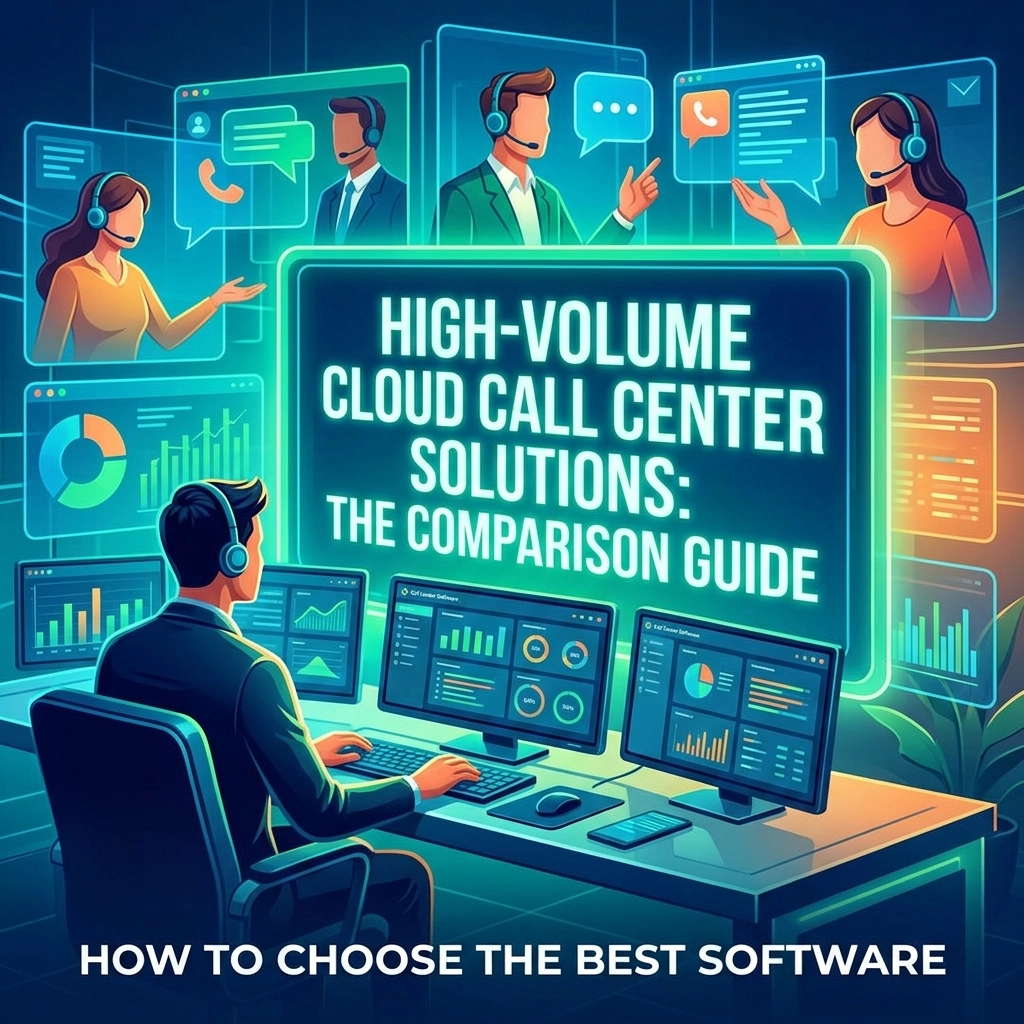
Managing a high-volume support center in today’s fast-paced business environment is no small feat. When your team is handling hundreds or thousands of calls daily, the technology behind those conversations isn't just a utility: it is the backbone of your customer experience. Legacy on-premise systems, once the gold standard, often struggle to keep pace with the scalability and flexibility required by modern Canadian enterprises.
If your current system is prone to dropped calls, limited reporting, or high maintenance costs, it’s likely time to consider a transition. Choosing a cloud PBX Canada solution allows businesses to move away from rigid hardware and toward a software-driven approach that scales instantly.
In this guide, we will break down the essential features of cloud call center solutions and compare the top contenders to help you make an informed decision for your high-volume support needs.
Why High-Volume Support Demands a Cloud-First Approach
The primary limitation of traditional hardware-based systems is their "ceiling." On-premise PBX systems require physical lines and hardware cards to expand. If you experience a sudden seasonal spike in call volume, you cannot simply "turn on" more capacity.
Cloud-based solutions, often referred to as Contact Center as a Service (CCaaS), operate on a completely different logic. Because the infrastructure is hosted in secure, redundant data centers, your capacity is virtually limitless. This shift from Capex (buying expensive servers) to Opex (a monthly subscription) is a major driver for business VoIP Canada adoption.
Beyond scalability, cloud solutions offer a unified view of the customer. High-volume support isn't just about phone calls anymore; it’s about managing SMS, email, and live chat within a single interface.

Key Features to Look for in a High-Volume Solution
When evaluating vendors, it is easy to get lost in a sea of features. For high-volume environments, however, five specific capabilities stand out as non-negotiable.
1. Intelligent Call Routing (ACD and IVR)
In a high-volume setting, every second a caller spends in the wrong queue is a second wasted. Advanced Automatic Call Distribution (ACD) uses algorithms to route calls based on agent skill level, language, or even customer priority. A robust Interactive Voice Response (IVR) system can deflect simple queries through self-service, leaving your human agents free to handle complex issues.
2. Workforce Management (WFM)
Predicting when you need ten agents versus fifty is a science. High-volume solutions often include WFM tools that analyze historical data to predict call patterns. This ensures you are never overstaffed (wasting money) or understaffed (frustrating customers).
3. Real-Time Analytics and Reporting
You cannot manage what you cannot measure. For high-volume support, you need dashboards that update in real-time. Key metrics like Average Handle Time (AHT), First Call Resolution (FCR), and Abandonment Rate should be visible at a glance.
4. Omnichannel Integration
Customers expect to move from a chat bot to a live agent without repeating their story. A true cloud call center solution syncs all these touchpoints. If you are using IP phones alongside digital tools, your software should bridge the gap seamlessly.
5. Robust CRM Integration
Your call center software should "talk" to your CRM (like Salesforce or HubSpot). When a call comes in, a screen pop should display the customer's history immediately. This reduces manual searching and significantly lowers the handle time per call.
Comparing the Top Cloud Call Center Solutions
To help you narrow down your search, we have compared four of the leading solutions used by high-volume support teams globally and in Canada.
Five9: The Enterprise Powerhouse
Five9 is widely regarded as a top-tier choice for large-scale operations. It is built specifically for the contact center environment rather than being a generic office phone system with call center features tacked on.
- Best for: Enterprises with 50+ agents and complex routing needs.
- Pros: Exceptional AI-driven features and predictive dialers.
- Cons: Can be more expensive and complex to set up than smaller competitors.
RingCentral Contact Center: The All-in-One Expert
RingCentral is a leader in the unified communications space. Their contact center solution is highly reliable and integrates perfectly with their existing office VoIP products.
- Best for: Businesses that want their call center and their back-office staff on the same platform.
- Pros: High reliability (99.999% uptime) and extensive global reach.
- Cons: The interface can feel a bit cluttered due to the sheer number of features.
Genesys Cloud CX: The King of Customization
Genesys is known for its flexibility. It offers a "composable" platform, meaning you can build exactly the workflow you need using their APIs.
- Best for: Tech-heavy organizations that want to integrate deep AI and self-service automation.
- Pros: Highly scalable and features some of the best self-service tools on the market.
- Cons: Usually requires dedicated IT resources to manage and customize properly.
Nextiva: The User-Friendly Choice
Nextiva focuses on the "Customer Experience" (CX) as a whole. Their platform is designed to be intuitive for agents, which is vital in high-volume settings where agent burnout is a risk.
- Best for: Mid-to-large businesses looking for a balance between power and ease of use.
- Pros: Excellent customer support and very clean user interface.
- Cons: Some of the advanced AI features are still catching up to Five9.

The Technical Infrastructure: Don't Ignore the Foundation
While the software lives in the cloud, your agents live in your office (or their home offices). For a high-volume call center to function, your local infrastructure must be flawless. Even the best business VoIP Canada solution will fail if your internet connection is unstable or your internal wiring is outdated.
The Role of Structured Cabling
High-volume voice traffic is sensitive to "jitter" and "latency." If your office relies on messy, outdated wiring, you will experience dropped packets and robotic-sounding voices. Professional structured cabling services ensure that your data moves efficiently from your ISP to your IP phones and computers.
Quality of Service (QoS)
Your business internet should be configured with QoS settings. This tells your router to prioritize voice traffic over other types of data (like someone downloading a large file in the accounting department). Without this, your call quality will suffer during peak usage times.
Implementation: Transitioning Without Downtime
The biggest fear for any high-volume support manager is "going dark" during a migration. To avoid this, we recommend a phased approach:
- The Audit: Review your current call flows and identify what works and what doesn't.
- The Sandbox: Set up a trial environment with your chosen provider to test integrations and routing rules.
- The Pilot: Move a small team (e.g., 5-10 agents) to the new system first to iron out any kinks.
- The Cutover: Once the pilot is successful, port your numbers and move the rest of the team.
Partnering with a local expert like Voiswitch can simplify this process. We specialize in both the cloud PBX software and the physical structured cabling required to make it work, providing a single point of accountability.

Final Verdict: Which One Should You Choose?
There is no "one size fits all" solution, but there is a "right" solution for your specific needs.
- If your primary goal is AI-driven efficiency and enterprise power, Five9 is a strong contender.
- If you need omnichannel flexibility with a focus on uptime, RingCentral is a safe bet.
- If you are a Canadian business looking for a reliable, high-performance Cloud PBX with local support and infrastructure expertise, Voiswitch offers the tailored approach that big-box providers often lack.
High-volume support is a high-stakes environment. By choosing a solution that prioritizes scalability, agent experience, and robust local infrastructure, you turn your support center from a cost center into a competitive advantage.
Ready to upgrade your communication? Whether you need new Grandstream IP phones or a complete cloud transition, our team is here to help. Contact us today to discuss how we can streamline your high-volume support.