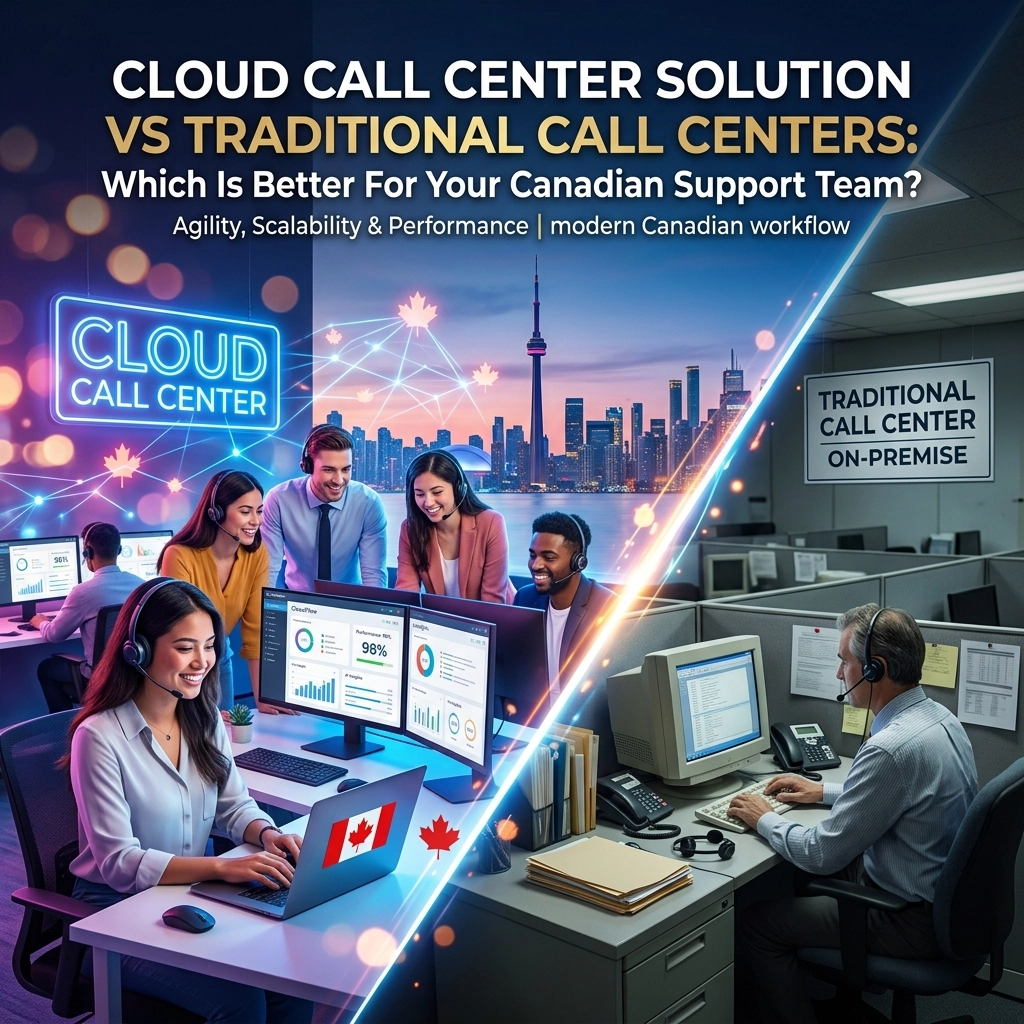
For decades, the image of a "call center" was a massive office floor filled with rows of cubicles, specialized hardware, and a server room humming in the background. In major Canadian hubs like Toronto, Montreal, or Vancouver, businesses invested millions in physical infrastructure to maintain their customer support operations.
However, the landscape of Canadian telecommunications is shifting. With the rise of high-speed business internet and the demand for flexible work arrangements, the "traditional" call center is facing stiff competition from cloud-based alternatives.
If you are a business owner or an IT decision-maker, you are likely weighing these two options. Do you stick with the reliability of on-premise hardware, or do you migrate to a cloud pbx canada model? This guide compares both systems through the lens of a Canadian business, helping you determine which is the better fit for your support team.
Defining the Two Contenders
Before comparing costs and features, it is essential to understand exactly what sets these two technologies apart.
What is a Traditional Call Center?
A traditional call center relies on on-premise hardware. This typically involves a Physical Branch Exchange (PBX) system installed directly in your office. Your team uses hardware IP phones connected via local area networks.
Setting this up requires significant structured cabling services to ensure that every desk has a dedicated, high-speed connection to the central server. The business owns the equipment, manages the software updates, and is responsible for all maintenance.
What is a Cloud Call Center?
A cloud call center: often referred to as Contact Center as a Service (CCaaS): operates entirely over the internet. There is no central "box" in your server room. Instead, the service provider hosts the infrastructure in a secure data center.
Your agents can log in from anywhere using a computer, a tablet, or a VoIP-enabled desk phone. This model leverages business voip canada technology to route calls through the cloud, requiring only a stable internet connection rather than a complex on-site hardware setup.

Cost Analysis: Capex vs. Opex
For most Canadian businesses, the decision often comes down to the bottom line. The financial models for these two systems are fundamentally different.
The Upfront Investment of Traditional Systems
Traditional call centers require a massive initial capital expenditure (Capex). You aren't just buying phones; you are buying servers, licenses, backup power supplies, and cooling systems for your server room. You also need to pay for professional installation and specialized structured cabling services to tie it all together.
Beyond the initial cost, there is the "hidden" cost of maintenance. When a card in your PBX fails, your team is offline until a technician can arrive on-site with a replacement.
The Predictability of the Cloud
Cloud solutions operate on an Operating Expenditure (Opex) model. You pay a monthly subscription fee per user. This eliminates the need for a massive upfront investment.
Key financial benefits of the cloud include:
- No Hardware Obsolescence: The provider handles all upgrades. You never have to worry about your server becoming "too old" to support new features.
- Reduced IT Overhead: You don’t need a full-time telecom engineer on-site to manage the system.
- Pay-as-you-go: If your support team grows from 10 to 50 people during a holiday rush, you simply add licenses. When the rush is over, you scale back down.
Scalability and Geographic Flexibility in Canada
Canada presents a unique challenge for support teams: geography. With five time zones and a population spread across thousands of kilometers, staffing a single physical location can be a logistical nightmare.
The Limitation of the Physical Office
In a traditional model, your talent pool is limited to people who live within commuting distance of your office. If you are based in a high-cost area like downtown Toronto, your labor costs will reflect that. Furthermore, providing 24/7 support requires staffing a physical building overnight, which comes with additional utility and security costs.
The "Hire Anywhere" Advantage
With a cloud pbx canada solution, your "office" is wherever your agents have an internet connection.
- National Talent Pool: You can hire a French-speaking agent in Quebec, a support lead in Calgary, and a night-shift worker in Halifax: all connected to the same system.
- Time Zone Coverage: By hiring across the country, you can provide "follow-the-sun" support without requiring any single employee to work the graveyard shift.
- Disaster Recovery: If a winter storm shuts down your main office, your team can simply work from home. Your customer service doesn't skip a beat.

Feature Sets and Integration
Modern customer support is no longer just about answering phone calls. It involves managing data, tracking metrics, and integrating with other business tools.
Traditional Systems: Stable but Rigid
On-premise systems are incredibly stable for voice calls. However, integrating them with modern Customer Relationship Management (CRM) tools like Salesforce or HubSpot can be difficult and expensive. Custom integrations often require "middleware" software and specialized programming, which adds to the complexity of the system.
Cloud Systems: Built for Integration
Cloud call centers are designed for the modern tech stack. Most business voip canada platforms offer "out-of-the-box" integrations.
- Screen Pops: When a customer calls, their account history automatically pops up on the agent's screen.
- Advanced Analytics: Managers can view real-time dashboards showing wait times, call abandonment rates, and agent productivity from any device.
- Omnichannel Support: Easily transition from a phone call to a web chat or SMS within the same interface.
Reliability and Quality of Service
A common concern for Canadian businesses is whether the internet is "ready" to handle a high-volume call center.
The Reliability of the "Wired" World
Traditional systems are often viewed as more reliable because they do not depend on your office's internet connection for internal calls. Even if your internet goes down, your internal extensions and on-site features might still function. This is why many high-security facilities still prefer on-premise hardware.
The Resilience of the Cloud
While cloud systems depend on the internet, they are often more resilient in a crisis. If your office loses power, a traditional PBX goes dark. A cloud system, however, remains active in the provider’s data center. Your calls can automatically be rerouted to mobile apps or secondary locations.
To ensure high quality, Voiswitch recommends a "Quality of Service" (QoS) configuration on your office router to prioritize voice traffic over standard data.

Which Is Better For Your Canadian Team?
To help you decide, let's look at the specific scenarios where each system shines.
Choose a Traditional Call Center if:
- You handle highly sensitive data: If you are in a sector with extreme regulatory requirements that forbid cloud storage of voice data.
- You already have the infrastructure: If your building already has professional structured cabling and you own a functioning PBX, the immediate move to the cloud might not be a priority.
- You have poor internet infrastructure: In very remote areas of Canada where high-speed fiber is not yet available, a traditional landline-based system may be more stable.
Choose a Cloud Call Center if:
- You want to reduce costs: You prefer a predictable monthly bill over large, unpredictable repair costs.
- You have a remote or hybrid team: You want the flexibility to hire the best talent across Canada, regardless of their location.
- You need to scale quickly: Your business is growing, and you don’t have time to wait weeks for hardware shipments and installation.
- You value data: You want deep insights into how your support team is performing through integrated analytics.
The Verdict
For the vast majority of Canadian support teams in 2026, the Cloud Call Center Solution is the clear winner. The combination of geographic flexibility, lower upfront costs, and superior integration with modern business tools makes it the most logical choice for a competitive business landscape.
While traditional systems served us well for decades, the transition to business voip canada is no longer a luxury: it is a necessity for staying agile.
If you are ready to explore how a modern cloud pbx canada can transform your customer support, the team at Voiswitch is here to help. From auditing your current structured cabling to setting up a fully remote support desk, we provide the expertise needed to keep your business connected.
Ready to make the switch? Contact Voiswitch today for a consultation tailored to your Canadian business needs.