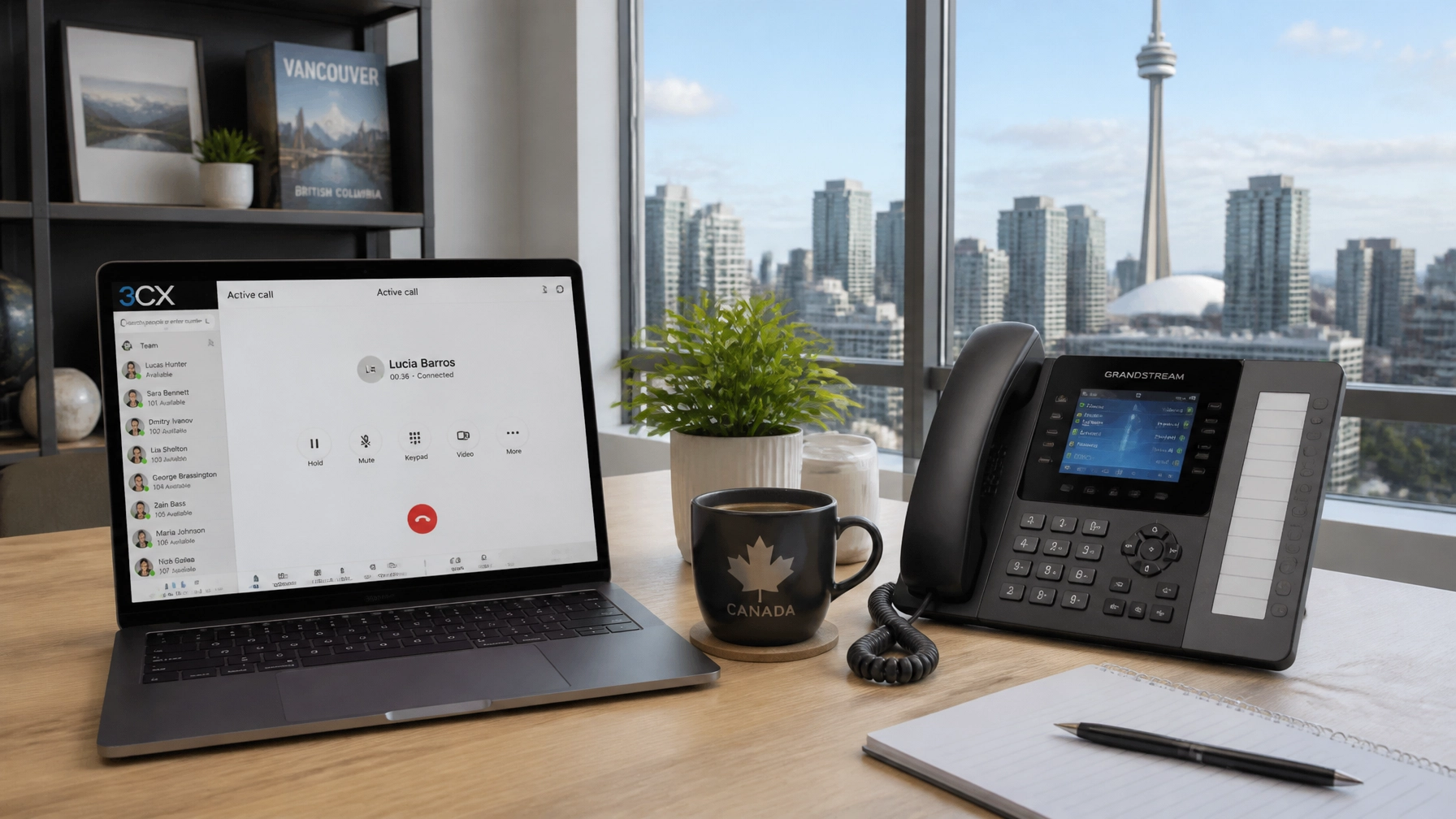
The landscape of business communication in Canada has undergone a massive shift. For decades, traditional on-premise PBX (Private Branch Exchange) systems were the gold standard. They were heavy, expensive, and required a dedicated room cooled by high-powered fans. Today, those systems have become liabilities: prone to failure, expensive to maintain, and completely incompatible with the modern mobile workforce.
In its place, Cloud PBX has emerged as the essential tool for Canadian businesses looking to stay competitive. Whether you are a small family-run shop in Ontario or a national enterprise with offices from Vancouver to Halifax, moving your telephony to the cloud is no longer just an "option": it is a strategic necessity.
This guide will walk you through everything you need to know about Cloud PBX in Canada, from how the technology works to choosing a provider that won't leave you hanging when you need support.
What Exactly is Cloud PBX?
At its simplest, a Cloud PBX is a virtual phone system that lives on the internet rather than in your office closet. It uses Voice over IP (VoIP) technology to transmit your voice as data packets across the web.
Instead of paying for multiple physical phone lines from a traditional carrier, you connect your office via your existing business internet. All the "brains" of the phone system: the call routing, the voicemail, the auto-attendants: are hosted in secure, redundant data centers.
Problem vs. Solution: The Legacy Trap
- The Problem: Traditional systems require physical hardware that depreciates instantly. If a card blows in your PBX or a storm knocks out the copper lines in your neighborhood, your business goes dark.
- The Solution: Cloud PBX removes the single point of failure. Because the system is hosted in the cloud, calls can be rerouted to mobile apps or other branch locations instantly, ensuring 100% uptime regardless of local office conditions.
Why Canadian Businesses Are Making the Switch
The Canadian market presents unique challenges: vast geographic distances, a growing hybrid workforce, and the need for seamless communication with US-based partners. Cloud PBX solves these issues through several key benefits.
1. Massive Cost Reductions
One of the most immediate impacts is on the bottom line. Traditional systems involve high upfront capital expenditures (CAPEX) for hardware and installation. Cloud PBX operates on a predictable monthly subscription (OPEX). Businesses typically see a 30% to 60% reduction in their monthly telecom bills by eliminating long-distance charges and maintenance contracts.
2. Built for Remote and Hybrid Work
In today’s Canadian business environment, your team might be working from a home office one day and the headquarters the next. With a Cloud PBX system, your business number follows you. You can answer calls on a professional IP phone at your desk, or via a softphone app on your laptop while traveling.
3. Effortless Scalability
If your business grows, you shouldn't have to call a technician to install new wires. With the cloud, adding a new user is as simple as clicking a button in a web portal and plugging in a new phone. This flexibility is vital for seasonal businesses or rapidly growing startups.

Essential Features for Success
Not all cloud phone systems are created equal. To truly succeed, your system should include these enterprise-grade features as standard:
- Auto-Attendant (IVR): A professional greeting that directs callers to the right department (e.g., "Press 1 for Sales, 2 for Support").
- Voicemail-to-Email: Receive your voicemails as audio files directly in your inbox, ensuring you never miss a message.
- Advanced Call Routing: Set rules to ring your desk phone first, then your mobile, then a colleague, ensuring no call goes unanswered.
- Call Analytics: Monitor call volumes, wait times, and abandoned calls to optimize your staffing levels and customer service.
- Integration with CRM: Link your phone system with tools like Salesforce or HubSpot so that customer records pop up automatically when they call.
The Role of Hardware: Do You Still Need a Desk Phone?
While you can run a business entirely on mobile apps, most Canadian professionals still prefer the reliability and audio quality of a physical desk phone. Modern IP phones and video phones provide dedicated hardware for crystal-clear voice processing, which avoids the "choppy" audio sometimes found on computer-based softphones.
For high-stakes environments like law firms, medical clinics, or busy reception desks, hardware like Grandstream devices offer programmable keys and expansion modules to handle multiple calls simultaneously.

Technical Requirements: Preparing Your Infrastructure
A Cloud PBX is only as good as the network it runs on. Before making the switch, it is crucial to evaluate two main areas: your internet connection and your internal wiring.
High-Speed Internet
Since your voice is now data, you need a stable Business Internet connection. We recommend a dedicated fiber connection or a high-speed coax line with a "Quality of Service" (QoS) configuration. QoS tells your router to prioritize voice data over other traffic (like someone downloading a large file), preventing dropped calls or lag.
Structured Cabling
Many businesses overlook their physical environment. If your office has old, cat5 wiring or messy server racks, you may experience connectivity issues. Professional structured cabling services ensure that every IP phone has a clean, high-speed path to the cloud.
Choosing the Right Partner in Canada
The biggest mistake business owners make is choosing a massive, "faceless" global provider. When your phones go down, you don't want to be stuck in a 45-minute queue for a call center in another time zone.
When evaluating a Canadian Cloud PBX provider, ask these questions:
- Do they offer 24/7 support? Business doesn't just happen 9-to-5. Look for a partner like Voiswitch that offers award-winning, round-the-clock support.
- Where is the data hosted? For compliance and latency reasons, it is often beneficial to work with a provider that understands the Canadian regulatory landscape and data residency requirements.
- Is it a complete solution? Do they just send you the phones, or do they help with the on-premise PBX installation, cabling, and network configuration?
Implementation Checklist: Your Path to the Cloud
Ready to upgrade? Follow this simple roadmap to ensure a smooth transition:
- Audit Your Current Usage: How many extensions do you need? Do you have toll-free numbers that need to be ported?
- Verify Network Readiness: Test your internet speed and check if your switches support Power over Ethernet (PoE) to power your new phones.
- Choose Your Hardware: Decide between standard IP phones, cordless models for mobility, or video phones for executives.
- Configure Your Workflow: Map out how you want calls to flow through your office. Who answers first? What happens after hours?
- Train Your Team: The best technology is useless if your staff doesn't know how to use it. Ensure they know how to transfer calls, access voicemail, and use the mobile app.

Conclusion: Future-Proofing Your Business
The move to Cloud PBX in Canada is more than just a technological upgrade: it's a move toward business agility. By removing the headaches of legacy hardware and high maintenance costs, you free up your team to focus on what matters: serving your customers and growing your company.
Whether you're looking for a simple hosted phone system or a complex Cloud Call Center solution, the cloud offers the reliability and flexibility required to succeed in today's market. Don't let your communication system be the thing that holds you back.