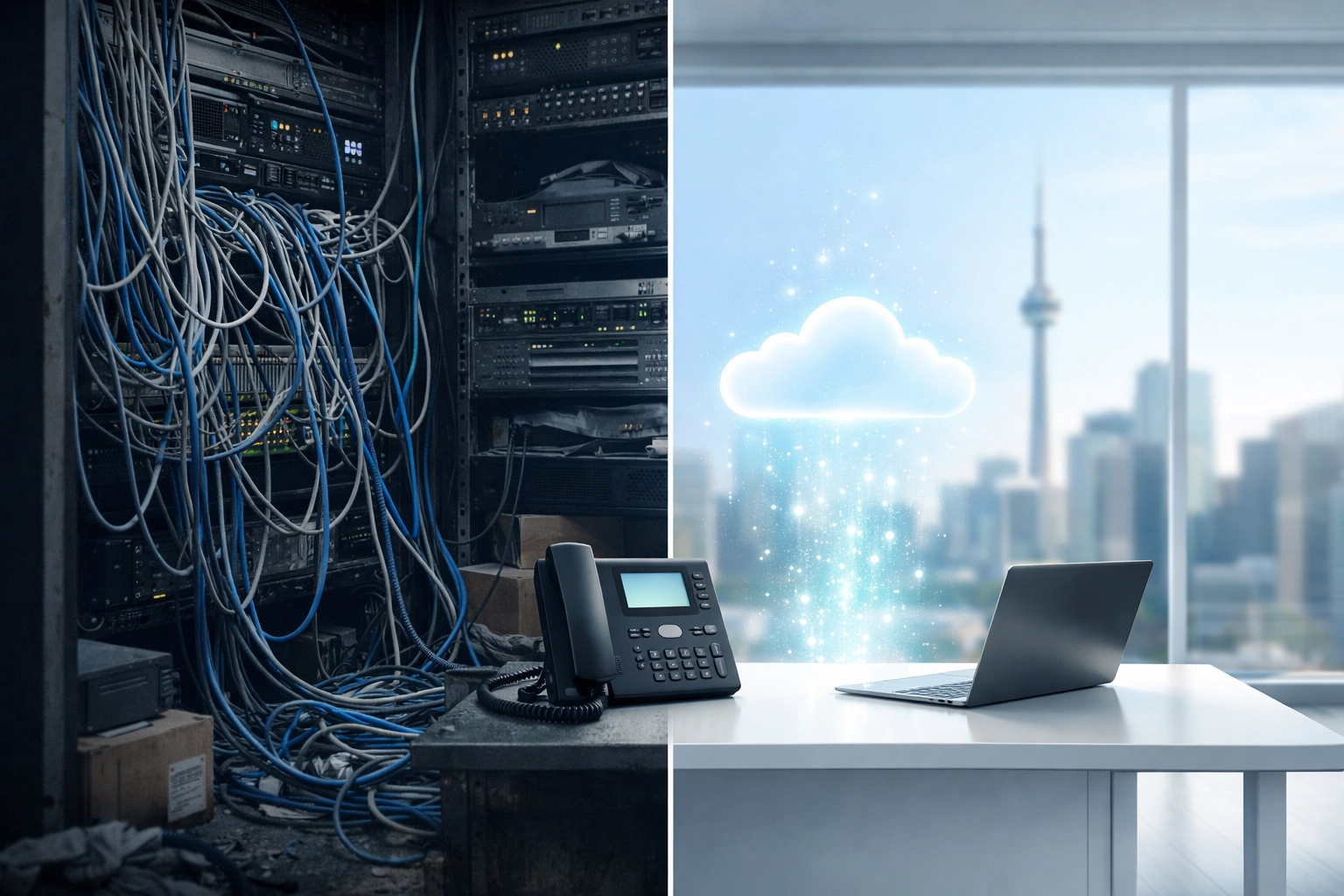
For decades, the heart of any Canadian office was a dusty utility closet filled with tangled wires and a humming metal box. This was the Private Branch Exchange (PBX): the gateway to the outside world. If your business wanted to grow, you didn’t just hire a new employee; you called a technician, ordered new hardware, and waited weeks for an installation.
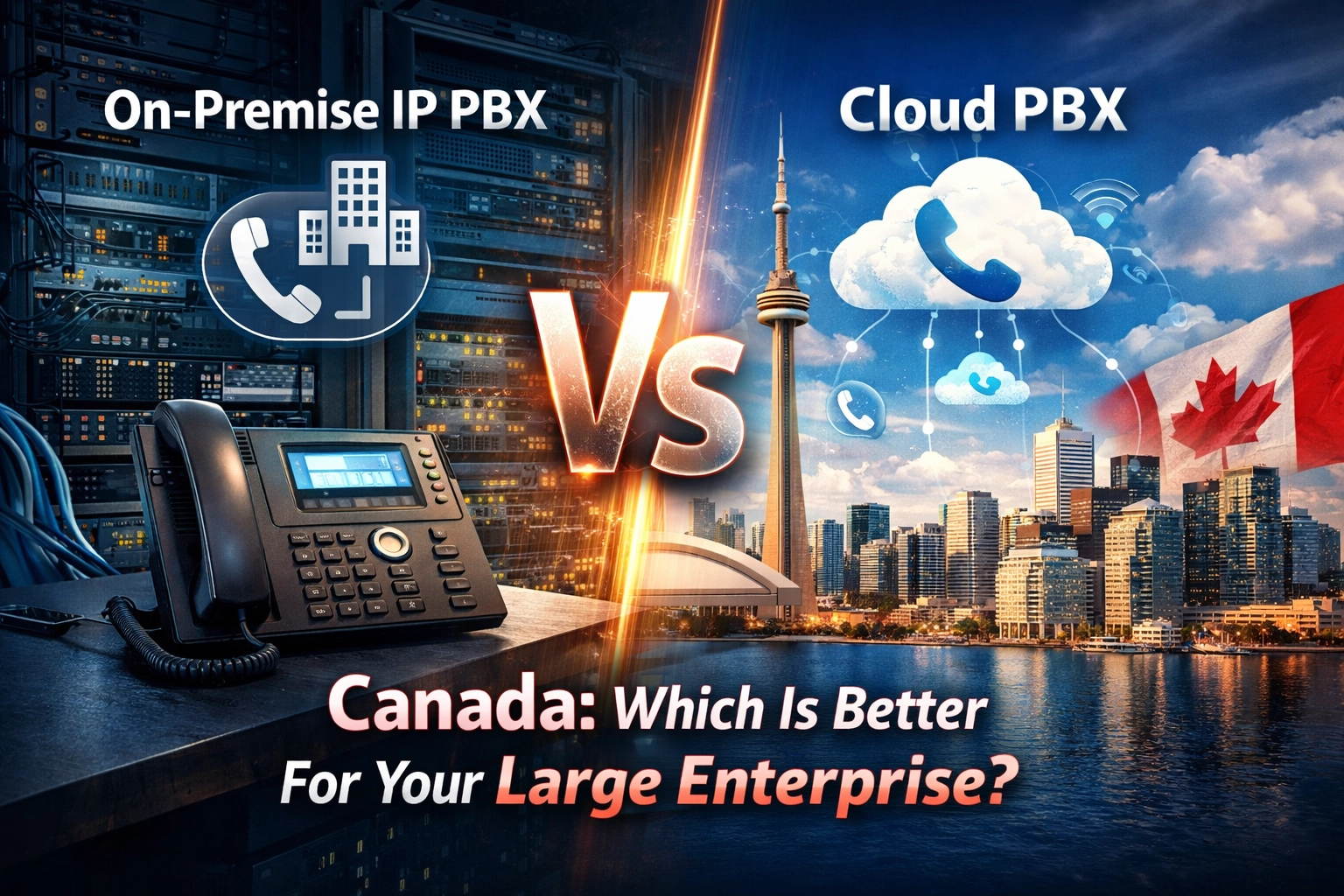
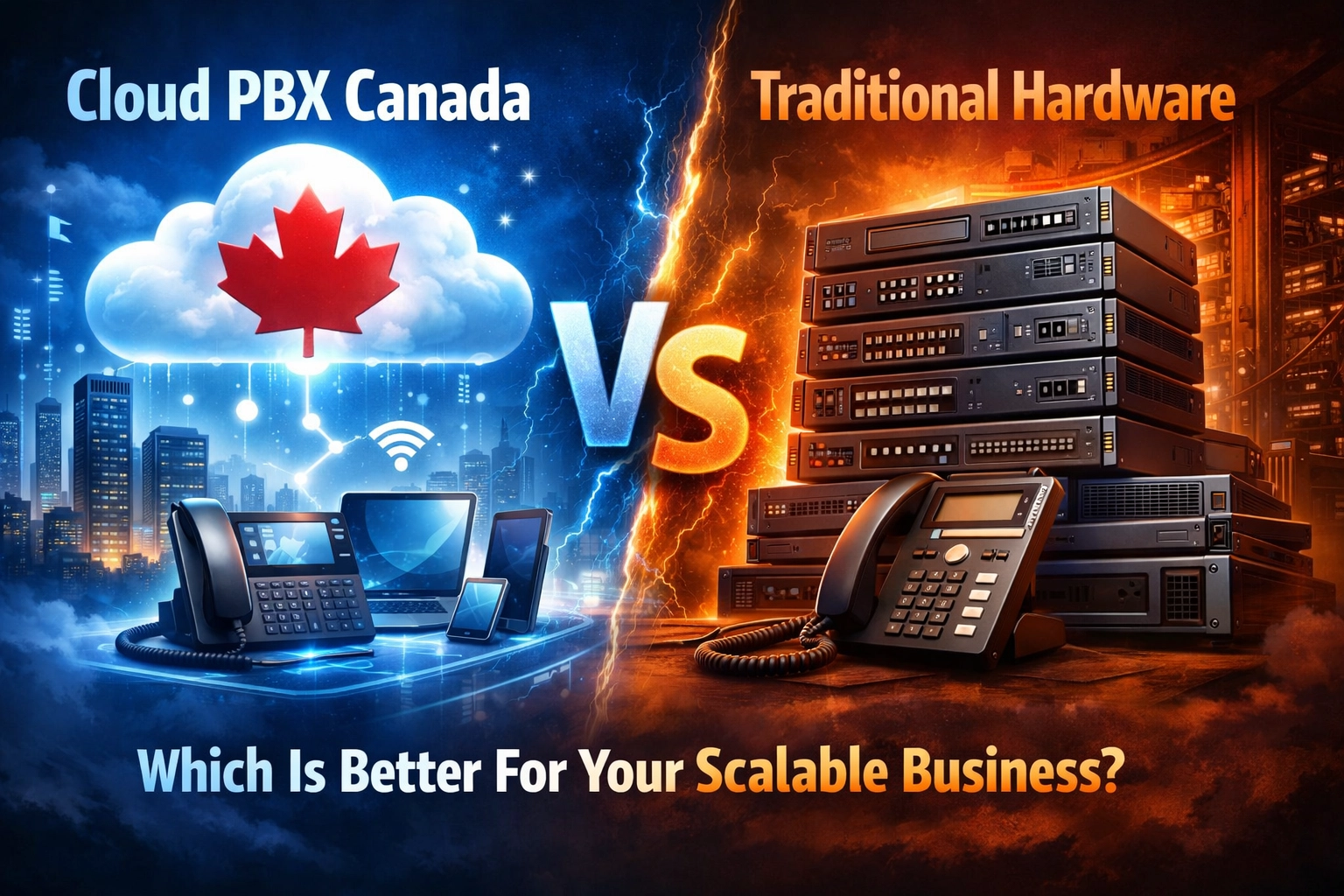
In today’s fast-paced market, that model is rapidly becoming a liability. As businesses across Canada shift toward remote work and rapid expansion, the debate between Cloud PBX Canada and traditional hardware has reached a tipping point. For a scalable business, the choice you make today will determine your operational agility for the next decade.
In this guide, we will break down the fundamental differences, costs, and strategic advantages of both systems to help you decide which path fits your growth trajectory.
What is Traditional PBX Hardware?
Traditional PBX, often referred to as "on-premise" PBX, is a physical telephone system located within your office building. It connects internal extensions to the Public Switched Telephone Network (PSTN) via physical copper lines or ISDN.
Scaling a traditional system is a manual process. It requires physical structured cabling services and the addition of "line cards" to the main unit to handle more users. Because it relies on physical infrastructure, it is a capital-intensive investment that ties your communication capabilities to a specific geographic location.
What is Cloud PBX?
Cloud PBX (also known as Hosted PBX or Business VoIP Canada) moves the "brains" of your phone system to a secure data center. Your phone calls are transmitted over the internet rather than traditional copper wires.
Instead of maintaining a server in your closet, you access your communication tools via the web. Your desk phones, mobile apps, and laptops connect to the provider’s server remotely. This shift from physical hardware to software-defined communication is what enables the high levels of flexibility that modern Canadian businesses crave.
Scalability: The Growth Factor
When we talk about a "scalable business," we mean a company that can increase its output or team size without being hampered by its underlying infrastructure. This is where the two systems diverge most sharply.
Scaling with Traditional Hardware
Scaling an on-premise system is a project. If you hire ten new employees, you must:
- Verify if your current PBX chassis has enough open ports.
- Purchase and install new hardware if the capacity is reached.
- Hire a technician to run physical wires to new desks.
- Manually configure each new extension.
This process can take weeks and involves significant "lumpy" costs. You often have to buy more capacity than you currently need just to be ready for future growth.
Scaling with Cloud PBX
With a Cloud PBX Canada solution, scaling is instantaneous. You log into a web portal, add a new user license, and the extension is live. There are no wires to pull and no hardware cards to install. Whether you are adding one employee in Toronto or an entire satellite office in Vancouver, the process is the same. This "pay-as-you-grow" model ensures that your communication costs scale linearly with your revenue.
A Cost Comparison: Capex vs. Opex
For Canadian business owners, the financial difference between these two systems usually comes down to Capital Expenditure (Capex) versus Operational Expenditure (Opex).
The Upfront Burden of Traditional PBX
Traditional systems require a massive upfront investment. You are paying for the server, the licenses, the handsets, and the professional installation. Furthermore, you are responsible for the ongoing maintenance. If a power surge fries your motherboard, you are looking at an expensive emergency repair bill. Research indicates that traditional systems often carry carrier charges and maintenance contracts that can bloat the total cost of ownership over five years.
The Predictability of Cloud PBX
Cloud PBX operates on a subscription model. Canadian businesses typically see savings of 40% to 60% when switching to the cloud. You eliminate the need for a server room, cooling costs for that room, and the need for specialized on-site IT staff to manage the phones.
Your costs are predictable: a fixed monthly fee per user. This allows for better budgeting and frees up capital that can be reinvested into your core business operations.

Reliability and Disaster Recovery
A common concern for businesses considering the move to the cloud is: "What happens if my internet goes down?"
While it is true that Cloud PBX requires a stable internet connection, it is actually more resilient than traditional hardware in a disaster scenario.
- Traditional PBX Vulnerability: If your office loses power, has a fire, or experiences a local circuit failure, your phones go dead. Calls cannot reach your building, and customers hear a busy signal or a generic "out of service" message.
- Cloud PBX Resilience: Because the system lives in the cloud, it is not tied to your physical office. If your office loses power, your IP phones might go off, but the system stays online. Calls can automatically reroute to mobile apps, home offices, or other branches. Your customers will never know there was a problem at your main location.
Maintenance: Who Holds the Wrench?
Maintenance is often the "hidden cost" of traditional telecommunications. Hardware ages, and software versions become obsolete.
With an on-premise system, you are responsible for security patches and firmware updates. If you fall behind, your system becomes vulnerable to toll fraud or hacking. You likely need a service level agreement (SLA) with a local vendor to ensure someone is available to fix hardware failures.
With Cloud PBX, the provider (like Voiswitch) handles everything. Updates are pushed automatically in the background. Security is managed at the data center level by experts. This removes the "headache" factor, allowing your team to focus on productivity rather than troubleshooting phone lines.
Advanced Features as Standard
In the past, advanced features like call recording, auto-attendants, and CRM integration were expensive add-ons for high-end enterprise systems.
Today, Business VoIP Canada brings these features to small and medium-sized businesses at no extra cost. Cloud systems are designed to integrate with the tools you already use. Imagine a world where:
- Your phone system automatically logs calls into your Salesforce or HubSpot CRM.
- Voicemails are transcribed and sent to your email.
- You can start a video conference directly from your desk phone interface.
For a scalable business, these features aren't just "nice to have": they are essential for maintaining professional standards as you grow.

When Should You Keep Traditional Hardware?
Is there ever a reason to stick with a traditional PBX? In 2026, the use cases are narrowing. If you operate in a extremely remote area of Canada with unreliable satellite internet and no fiber access, a traditional system using landlines might be more stable. Similarly, if your business has already spent tens of thousands of dollars on a brand-new system in the last two years, you might choose to "ride out" the investment until the hardware reaches its end-of-life.
However, even in these cases, many businesses are choosing to use VoIP Adapters (ATA) to bridge the gap between their old hardware and modern cloud benefits.
The Role of Hardware in a Cloud World
Moving to the cloud doesn't mean giving up physical phones. Many professionals still prefer the tactile feel of a high-quality desk phone. The difference is that these phones are now "intelligent" devices.
You can choose from a wide range of hardware that fits your specific needs:
- Executive Offices: High-definition video phones for face-to-face collaboration.
- Reception Desks: Phones equipped with expansion modules to manage dozens of lines at once.
- Warehouse Environments: Ruggedized cordless phones that allow for mobility across large floor plans.
The hardware becomes an extension of the cloud, easily plugged into any ethernet port with a basic understanding of your routers and network settings.
Final Verdict: Which is Better for Your Business?
For the vast majority of Canadian businesses looking to scale, Cloud PBX is the clear winner.
The combination of lower upfront costs, instant scalability, and built-in disaster recovery makes it the superior choice for a modern workforce. Traditional hardware served its purpose for a century, but in an era of hybrid work and global competition, it simply cannot keep up with the speed of the cloud.
If you are currently struggling with an aging phone system or planning a major expansion, now is the time to evaluate your options. Transitioning to a cloud-based system isn't just a technical upgrade: it’s a strategic move that prepares your business for the future.
At Voiswitch, we specialize in helping Canadian businesses navigate this transition. Whether you need expert advice on structured cabling services or want to explore the latest Grandstream IP PBX solutions, our team is here to ensure your communication infrastructure is an asset, not a liability.
Ready to make the switch? Explore our blog for more tips on optimizing your business communications or contact us today to build a system that grows with you.