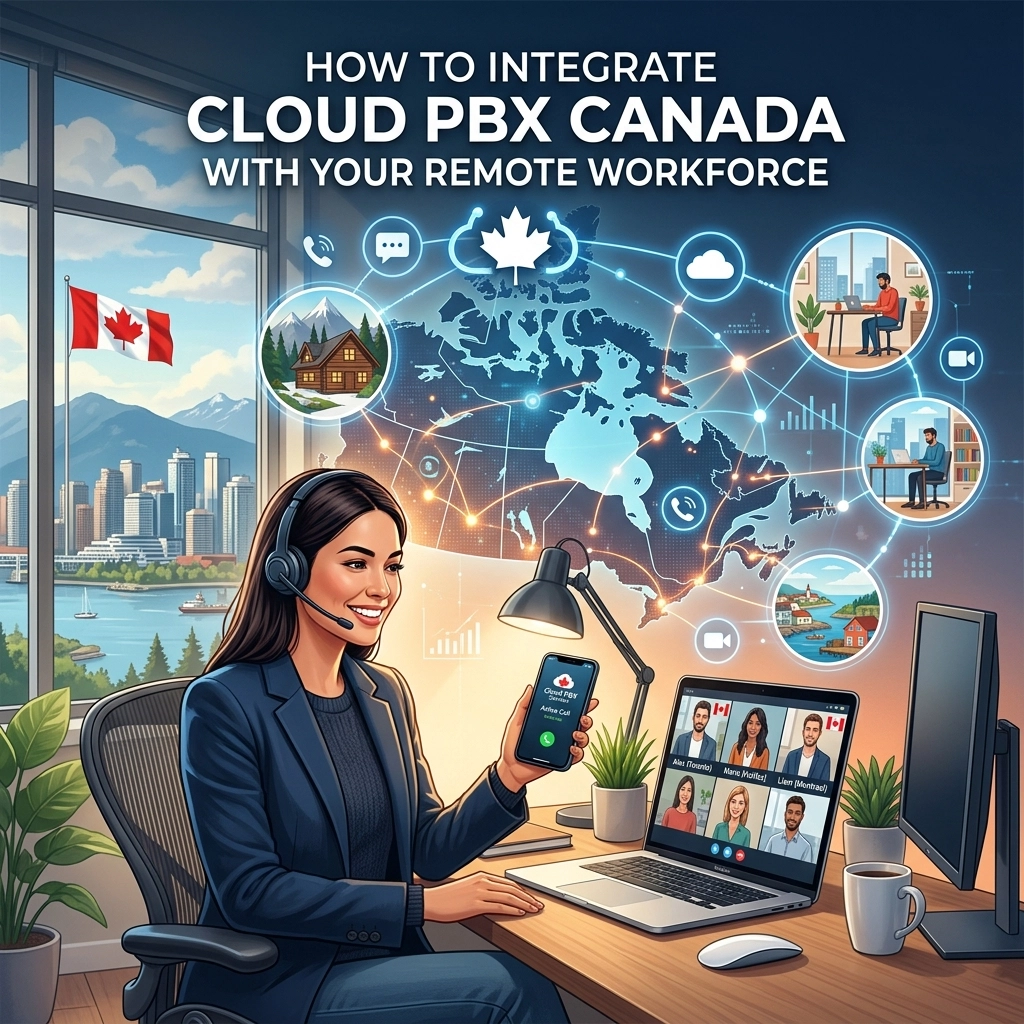
Why are legacy phone systems a problem for remote teams?
A traditional on-prem PBX was built for a simple reality: everyone works in the same building, on the same LAN, using desk phones that never move. That model breaks down the minute your team starts working from home, from client sites, or across provinces.
Common issues Canadian businesses run into with legacy systems include:
- Hard location dependency: extensions are tied to a physical port or office phone.
- Limited scalability: adding users often means buying cards, licensing, and sometimes new hardware.
- Complicated call forwarding: “temporary” forwarding becomes permanent chaos, especially when staff rotate.
- Risky workarounds: employees use personal mobile numbers, which hurts privacy, reporting, and brand consistency.
- Support headaches: troubleshooting becomes “Is it the PBX? the router? the VPN? the user’s home Wi‑Fi?”
A modern cloud PBX Canada deployment solves these with the right integration plan: one that treats remote endpoints, security, and call routing as first-class requirements.
What does “Cloud PBX Canada” mean in practical terms?
A cloud PBX is your business phone system hosted in the cloud, managed through a web portal, and accessed via:
- desk IP phones (where it makes sense)
- desktop softphones
- mobile apps
- browser calling (in some environments)
- SIP-enabled conference devices
Instead of building your operations around a phone closet, you build them around users, teams, and workflows. For organizations searching for business voip canada, the key differentiator is that cloud PBX is designed for mobility by default: while still supporting desk phones in offices, warehouses, or front desks.
If you’re evaluating options, Voiswitch’s Cloud PBX overview is here: https://voiswitch.net/cloud-pbx
What should you plan before you roll out Cloud PBX to remote employees?
Cloud PBX is straightforward to deploy, but remote work introduces variability (home networks, consumer routers, shared Wi‑Fi). A short planning step prevents long-term support tickets.
Start with these decisions:
1) Who needs which type of endpoint?
Map roles to endpoints so you’re not overspending or under-equipping teams.
- Softphone-first: sales, support, managers, most admin roles
- Desk phone + softphone: reception, dispatch, finance (high call volumes)
- Common area phones: warehouses, break rooms, entry points
2) What call flows must remain consistent?
Document what “good” looks like:
- business hours vs after-hours routing
- overflow rules when queues are busy
- voicemail-to-email requirements
- department ring groups
- on-call rotations
3) What are your Canadian compliance and safety needs?
Remote work changes how you think about emergency calling. If employees are mobile, you need a process for keeping location info current and training staff on expectations. Voiswitch has guidance here: https://voiswitch.net/911-explained
How do you connect remote staff: softphones, mobile apps, or desk IP phones?
For remote workforce integration, most Canadian businesses succeed with a softphone + mobile app strategy, backed by desk phones only when needed.
Softphones (desktop apps)
Best for staff who live in their CRM and email all day.
Benefits:
- quick deployment (no shipping hardware)
- headset-based ergonomics for long calls
- easier screen-based transfers and conferencing
- consistent caller ID and call history
Implementation tips:
- standardize headsets (USB is simplest)
- define minimum PC specs and OS versions
- make sure users can access required ports and domains (avoid “mystery blocks”)
Mobile apps
Best for field teams, management, and hybrid staff.
Benefits:
- business calls from a business number
- easy availability while traveling
- fewer missed calls when away from desk
- SMS or messaging options (depending on configuration)
Implementation tips:
- clarify whether calls should use cellular voice vs VoIP over data/Wi‑Fi
- require screen lock + device PIN for account protection
- document how to switch profiles or devices during phone upgrades
Desk IP phones
Still valuable in certain environments.
Best for:
- front desk/reception
- high-volume call handling (tactile keys help)
- shared spaces where multiple staff rotate
Implementation tips:
- pre-provision phones before shipping
- use QoS and stable Ethernet where possible (Wi‑Fi phones are often a compromise)
- label phones with extension/user assignment

How do you set up call routing so customers always reach the right person?
Remote work doesn’t reduce customer expectations. If anything, callers expect faster answers and smoother transfers. The goal is to make location irrelevant.
A reliable routing design typically includes:
Ring groups and department numbers
Instead of calling individuals, customers call Sales, Support, or Accounting. The PBX decides who rings.
Recommended patterns:
- Simultaneous ring for small teams
- Hunt sequence for specialized roles
- Round-robin to distribute workload fairly
Queues for peak volume
Queues help you avoid “busy tone” failures and improve consistency.
Queue features to use:
- estimated wait time announcements
- overflow to voicemail or another team after X minutes
- priority routing for VIPs (if supported)
- reporting on abandoned calls and answer time
Time-of-day and holiday schedules
Remote teams often have flexible hours, but your phone system should still communicate clearly.
Set:
- office hours per department
- holiday closures
- after-hours voicemail or on-call routing
- regional variations (e.g., Atlantic vs Pacific customers)
Failover rules
Internet outages happen. Your Cloud PBX should have a plan.
Examples:
- if an agent is unreachable, route to mobile app
- if the queue is unavailable, route to a backup DID
- if the site goes down, switch to an alternate greeting and voicemail
How do you integrate Cloud PBX with CRM and business apps (without slowing teams down)?
A remote workforce loses time when tools are disconnected. A major reason companies adopt business voip canada solutions is to reduce app switching and manual logging.
Practical integration goals:
- Click-to-call inside your CRM or browser
- Screen pops on inbound calls (who’s calling, open tickets, last notes)
- Call logging automatically (time, duration, disposition)
- Voicemail-to-email to keep communication in one place
- Shared contacts so staff don’t maintain personal address books
Even without a deep custom integration, you can still streamline remote workflows by standardizing:
- call disposition notes (short, consistent templates)
- recorded call storage rules (where permitted)
- shared team inboxes for voicemail notifications
Tip: choose one or two “source of truth” systems (CRM + ticketing). Avoid building process around individual inboxes; remote work makes that ungovernable quickly.
What network basics must remote employees get right?
Cloud PBX quality is usually not “a VoIP problem”: it’s a network consistency problem. With remote teams, you can’t fully control home networks, but you can set a baseline.
Minimum recommendations for remote VoIP:
- stable broadband connection
- modern router (ISP-supplied units can be hit-or-miss)
- wired Ethernet for heavy callers when possible
- avoid congested guest Wi‑Fi networks
What about offices or shared hubs?
Many businesses in Canada now run “light offices” (hot desks + meeting rooms) while staff rotate. That’s where structured network work matters.
If you have any physical locations, plan:
- proper patch panels and labeling
- dedicated drops for phones and access points
- clean rack layout and power management
- capacity for growth
If you’re upgrading a site to better support hybrid work, structured cabling matters as much as the PBX. Relevant service page: https://voiswitch.net/structured-cabling

How do you handle security and access control for remote calling?
Remote access expands your attack surface. The goal isn’t to make users jump through hoops: it’s to prevent account takeovers, toll fraud, and data exposure.
Recommended controls:
- strong passwords and password rotation policies
- MFA where supported (especially for admin portals)
- role-based access: keep admin permissions limited
- international calling controls: only enable where needed
- call recording access restrictions: recordings can contain sensitive info
- device hygiene: require OS updates on softphone devices
Operational best practice: define who can change call forwarding, who can create users, and who can export call logs. In many businesses, those permissions were “whoever has the PBX password,” which is a liability in a remote-first environment.
How do you onboard remote employees quickly (and consistently)?
One of the biggest wins of Cloud PBX is speed: new users can be provisioned in minutes. But “fast” only helps if onboarding is consistent.
A simple onboarding checklist:
- create user + extension
- assign DID (if required) and caller ID
- add to ring group / queue
- configure business hours rules
- enable voicemail-to-email
- set up softphone + mobile app
- confirm headset and audio devices
- run a 5-minute test: inbound, outbound, transfer, voicemail
Create two standard user profiles:
- Standard User (Remote)
- Power User / Call Queue Agent
This reduces custom setups and makes troubleshooting easier because everyone’s configuration is predictable.
What should you monitor after go-live to avoid “silent failures”?
Remote voice issues can hide until a customer complains. Monitoring should focus on both quality and process.
Track these metrics:
- missed calls and abandoned queue calls
- average speed of answer (ASA)
- peak calling times by department
- repeated transfers (a sign routing is wrong)
- failed registrations (users who can’t connect)
- call quality complaints correlated by ISP or region
Also review:
- are staff forwarding to personal numbers (a policy issue)?
- are after-hours calls being handled as intended?
- do customers reach the right team on the first try?
A short optimization cycle (weekly for the first month) usually eliminates most friction.

Cloud PBX vs. “just use cell phones”: what’s the real difference?
Some businesses try to solve remote work by letting everyone use mobile phones. That approach looks simple, but it introduces hidden costs and risks.
Cell-phone-only approach drawbacks:
- no consistent caller ID for the business
- limited reporting and quality tracking
- hard to manage onboarding/offboarding (numbers live with employees)
- messy call transfers and shared lines
- weak integration with CRM and call queues
Cloud PBX Canada benefits for remote teams:
- business identity stays with the company
- centralized call routing, greetings, and schedules
- visibility into performance and customer experience
- easier scaling up/down with staffing changes
- better continuity during turnover
For many Canadian organizations, Cloud PBX is less about “new features” and more about removing operational liabilities that show up when teams become distributed.
What does a practical integration rollout look like for Canadian SMBs?
A realistic rollout plan (that minimizes downtime) looks like this:
- Discovery (1–2 days): users, numbers, call flows, peak volumes, current pain points
- Design (1–3 days): routing, queues, schedules, failover, device strategy
- Pilot (1 week): small group (sales + one admin + one queue agent), adjust configs
- Porting + go-live: staged by department, with a clear cutover window
- Optimization (2–4 weeks): tune routing, queue prompts, reporting, and training
If you’re planning a move and want to scope it properly, Voiswitch Cloud PBX info is here: https://voiswitch.net/cloud-pbx-lp and support resources here: https://voiswitch.net/support
Quick checklist: “Are we ready to integrate Cloud PBX with a remote workforce?”
Use this to sanity-check your plan before committing:
- Every role has the right endpoint (softphone/mobile/desk phone)
- Department call flows are documented (hours, overflow, after-hours)
- Queues and ring groups are configured and tested
- CRM/email integrations are defined (at least click-to-call + logging plan)
- Remote network baseline is communicated to staff
- Security controls are in place (roles, MFA, international dialing policy)
- 911 and location expectations are documented and trained
- Monitoring and reporting cadence is set for the first month
A Cloud PBX deployment done right makes remote work feel “normal” for customers and predictable for your team: without the ongoing headaches that come from patching a legacy PBX to fit a modern workforce.