
Structured Cabling for Canadian Businesses: The Backbone of Reliable VoIP and Network Performance
In the modern business landscape, connectivity is no longer just a utility: it is the lifeblood of operations. For Canadian businesses, the transition to digital-first communication tools like Cloud PBX and unified communications has made the underlying network infrastructure more critical than ever. However, many organizations overlook the physical foundation of this digital world: the cabling.
If your office network resembles a "spaghetti closet" of tangled wires, your high-speed internet and expensive VoIP systems are likely underperforming. Structured cabling is the solution to this invisible bottleneck. By implementing a standardized, professional cabling system, businesses can ensure that their communication tools operate at peak efficiency. This guide explores why structured cabling is the essential backbone for reliable network performance and how choosing the right standards can future-proof your business.
What is Structured Cabling and Why Does It Matter for VoIP?
Structured cabling is a comprehensive system of cabling and associated hardware that provides a complete telecommunications infrastructure. Unlike traditional point-to-point wiring: where cables are run haphazardly from one device to another: structured cabling follows strict industry standards (such as TIA/EIA) to create a predictable, manageable, and scalable network.
For businesses utilizing business VoIP in Canada, the quality of the physical cable directly impacts call clarity and reliability. Voice over IP (VoIP) is highly sensitive to network issues like latency (delay), jitter (variation in delay), and packet loss. When cabling is poorly installed or damaged, signal interference can cause audio to drop, echo, or sound "robotic."
The "Problem vs. Solution" of Legacy Wiring
- The Problem: Ad-hoc wiring creates "noise" and signal degradation. As you add more devices, the lack of organization makes it impossible to troubleshoot hardware failures without causing massive downtime.
- The Solution: Structured cabling organizes your network into manageable sub-systems. This layout reduces electromagnetic interference and provides the consistent bandwidth required for high-definition voice and video traffic.
The Technical Breakdown: Cat5e vs. Cat6 vs. Cat6a
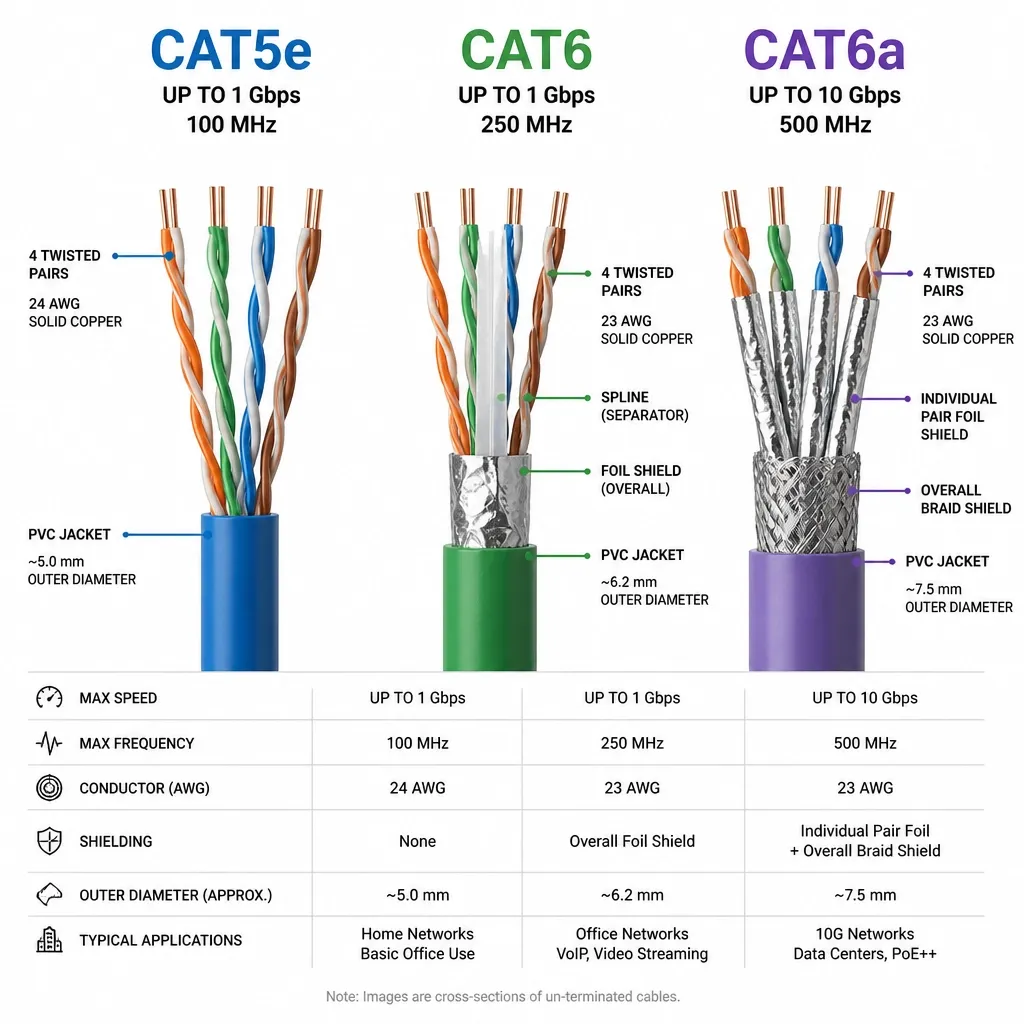
Choosing the right category of ethernet cable is one of the most important decisions during a network refresh. While they may look similar on the outside, the internal capabilities vary significantly in terms of speed, distance, and noise resistance.
Cat5e: The Aging Standard
Category 5e (Enhanced) was the workhorse of the early 2000s. It supports speeds up to 1 Gbps (Gigabit Ethernet) at a frequency of 100 MHz. While it is technically capable of supporting standard VoIP calls, it lacks the shielding and "twist" density required to handle high-density data environments or future 10-Gigabit speeds. For a modern office, Cat5e is often considered the bare minimum and is rapidly becoming obsolete.
Cat6: The Current Professional Choice
Category 6 is the recommended standard for most new commercial structured cabling services. It offers significantly more bandwidth (up to 250 MHz) and can support speeds of 10 Gbps over shorter distances (up to 55 meters). More importantly, Cat6 cables feature a longitudinal separator (a "spline") that keeps the wire pairs separated, drastically reducing crosstalk and interference: the primary enemies of VoIP call quality.
Cat6a: Future-Proofing Large Operations
Category 6a (Augmented) is designed for 10 Gbps performance over the full 100-meter length of the cable. It operates at frequencies up to 500 MHz and features even more robust shielding. For Canadian enterprises with large floor plans, high-density server rooms, or heavy reliance on video conferencing and Cloud PBX Canada features, Cat6a provides the necessary "headroom" to ensure the network won't need an expensive replacement for the next 15–20 years.
| Feature | Cat5e | Cat6 | Cat6a |
|---|---|---|---|
| Max Speed | 1 Gbps | 10 Gbps (to 55m) | 10 Gbps (to 100m) |
| Bandwidth | 100 MHz | 250 MHz | 500 MHz |
| Crosstalk Resistance | Low | High | Excellent |
| Ideal For | Small legacy offices | General business use | High-density/Future-proof |
The Art of Organization: Cable Management Best Practices
A professional installation is about more than just pulling wires through a ceiling. Proper cable management ensures that your infrastructure is easy to maintain and less prone to physical failure.
- Effective Labeling: Every cable should be labeled at both ends. Using a standardized numbering scheme that matches your patch panel and wall jacks allows technicians to identify and fix issues in minutes rather than hours.
- Using Patch Panels: Instead of plugging cables directly into a switch, they should terminate at a patch panel. This protects the permanent "horizontal" cabling from the wear and tear of being plugged and unplugged.
- Mind the Bend Radius: Copper cables are sensitive. Bending them too sharply can "kink" the internal wires, leading to intermittent connectivity issues that are notoriously difficult to diagnose.
- Separation from Power Lines: Data cables should never be run parallel to electrical power lines for long distances. The electromagnetic field from the power lines can bleed into the data lines, causing "noise" that disrupts VoIP packets.
How Professional Installation Reduces Downtime
Many business owners are tempted to treat cabling as a DIY project or a task for a general handyman. However, a lack of professional expertise often leads to "hidden" liabilities.
Certification and Testing
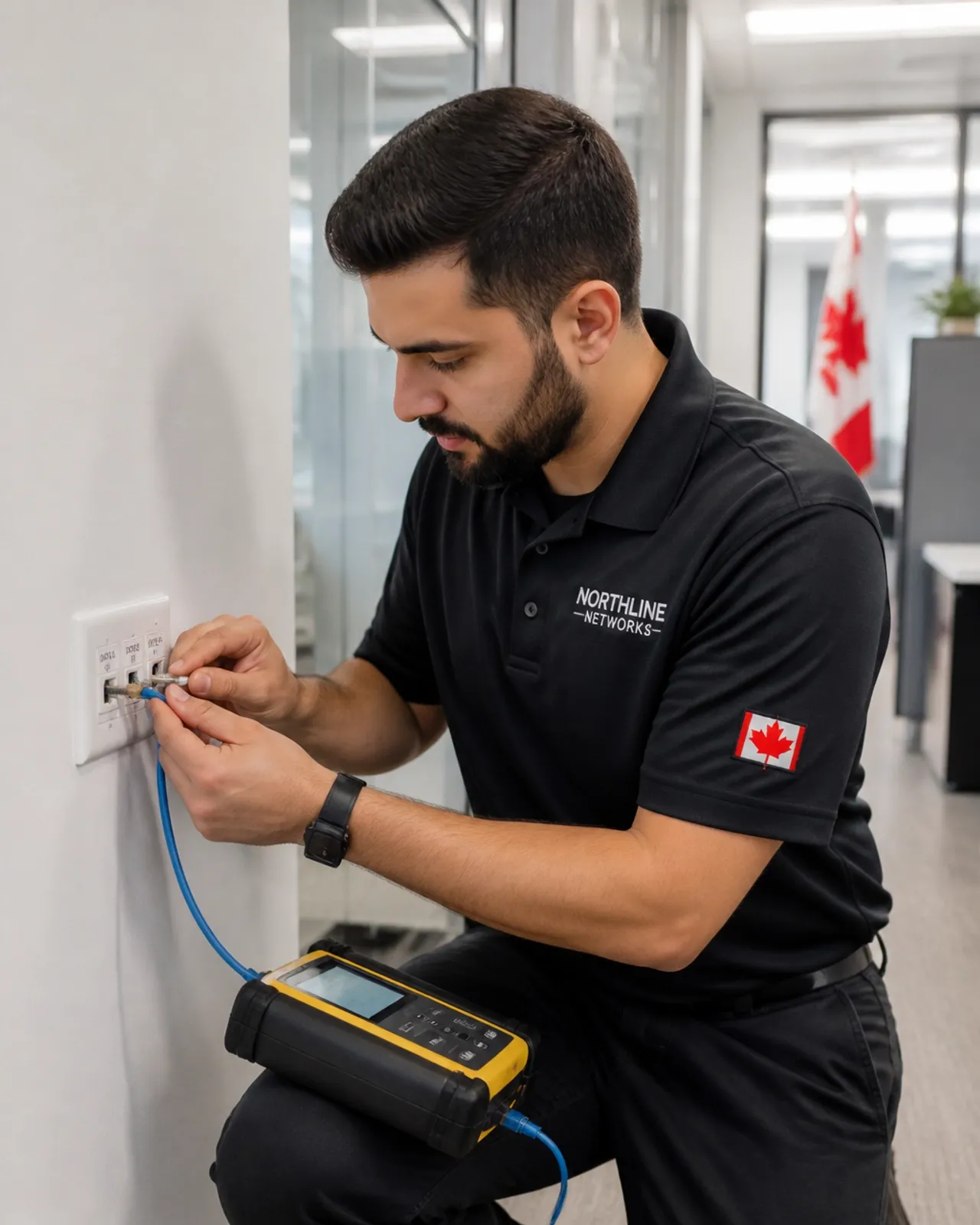
A professional provider doesn't just "see if the light turns on." Companies like Voiswitch use specialized Fluke testers to certify every single drop. This process confirms that the cable meets the actual performance specifications for its category. If a cable is poorly terminated, it might work at slow speeds but fail when the network is under heavy load: such as during a company-wide video meeting.
Standardized Routing
Professional installers use dedicated cable trays, J-hooks, and racks to keep bundles neat. This prevents "cable stress," where the weight of a tangled mess of wires eventually pulls connectors loose or causes internal wire fractures.
Reduced Troubleshooting Time
When an employee reports that their SIP Trunk or desk phone is cutting out, a structured system allows your IT team (or your service provider) to isolate the problem instantly. If the cabling is structured, you can quickly determine if the issue is a faulty patch cord, a switch port, or the internal wiring.
Voiswitch: Your Partner for End-to-End Communication in Canada
At Voiswitch, we understand that a hosted phone system is only as good as the network it runs on. That is why we don't just sell software; we provide complete, end-to-end communication solutions. Our structured cabling services are designed to integrate seamlessly with our Cloud PBX and Business Internet offerings.
By choosing Voiswitch for your infrastructure needs, you benefit from:
- 24/7 Support: We manage both your phones and the cables they connect to, meaning there is "one neck to wring" if something goes wrong.
- Custom Design: Whether you are a small family-run retail shop or a multi-floor corporation, we design a cabling layout that fits your specific spatial and bandwidth requirements.
- Seamless Integration: We ensure your cabling is optimized for Power over Ethernet (PoE), allowing your VoIP phones to receive power and data through a single cable, reducing clutter at the desk.

Conclusion: Future-Proofing Your Business Connectivity
The physical layer of your network: the cables in your walls and the racks in your closet: is a long-term investment. While software and hardware are upgraded every few years, a high-quality structured cabling system can last two decades.
Investing in Cat6 or Cat6a today ensures that as Canadian businesses continue to adopt more advanced technologies: like AI-driven call centers, 4K video conferencing, and massive IoT deployments: your infrastructure will be ready to handle the load. Don't let your business be held back by the "spaghetti" of the past. Ensure your communication is clear, reliable, and professional with a foundation built on quality.
Ready to upgrade your business backbone?Contact Voiswitch today to learn how our structured cabling and VoIP solutions can streamline your Canadian business.
By Voiswitch