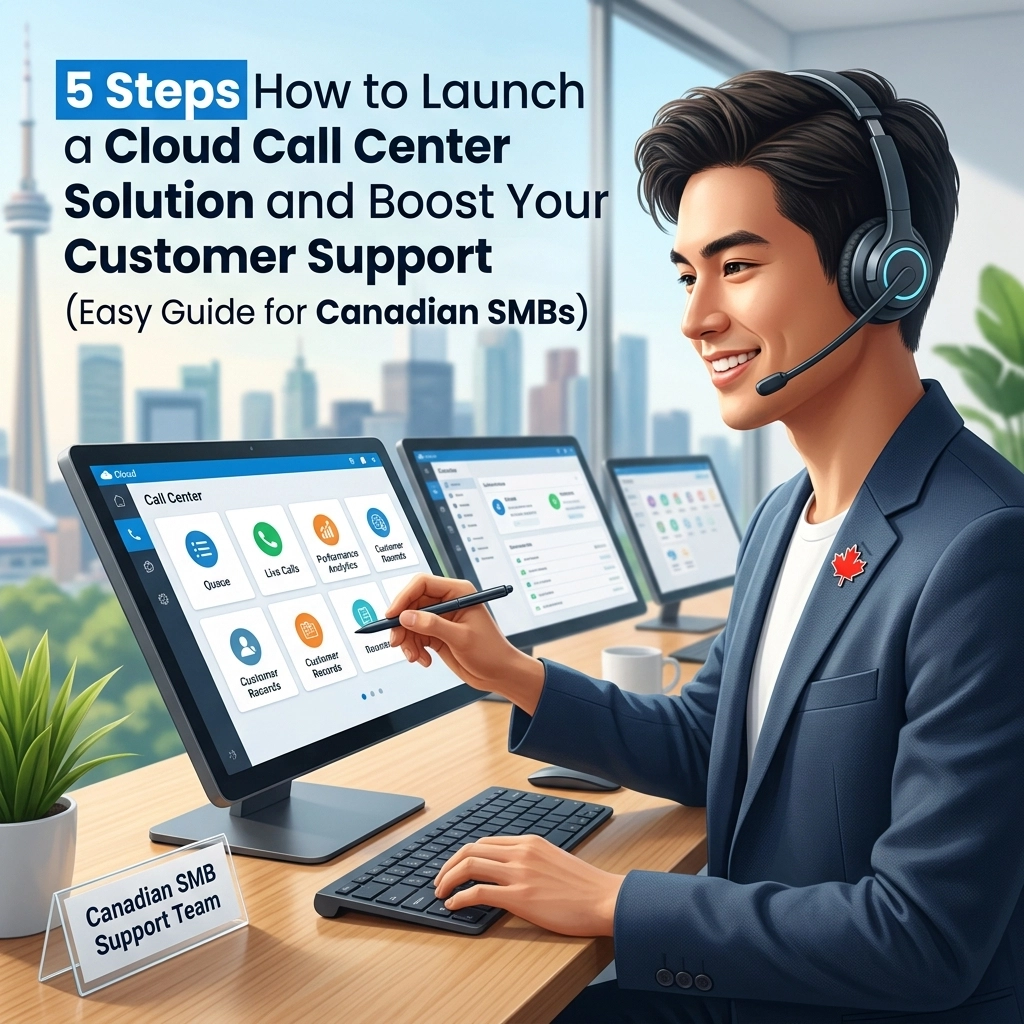
For years, Canadian small and medium businesses (SMBs) were tethered to physical office spaces by massive, expensive hardware known as "on-premise PBX." If you wanted a professional call center, you needed a dedicated server room, an army of IT consultants, and a massive upfront capital investment.
Today, the landscape has shifted. The rise of business VoIP Canada has leveled the playing field, allowing a small boutique in Halifax or a growing tech firm in Kitchener to deploy the same high-level communication tools used by global enterprises.
Transitioning to a cloud call center isn’t just about making phone calls over the internet; it’s about transforming your customer support from a cost center into a competitive advantage. If you are still managing customer calls with a traditional landline or a basic cell phone, you are likely missing out on data, efficiency, and: most importantly: customer satisfaction.
This guide breaks down the five essential steps to launching a professional cloud call center solution tailored for the Canadian market.
Step 1: Audit Your Current Communication "Headaches"
Before you look at software or pricing, you must understand where your current system is failing. Many SMBs suffer from "hidden" communication gaps that frustrate customers and burn out employees.
Start by asking these questions:
- Are customers waiting on hold for too long without knowing their place in line?
- Do your agents have to manually log call details into a CRM?
- Can your support team work from home, or are they tied to a desk in the office?
- How much are you paying for long-distance calls across provinces?
In the world of cloud PBX Canada, the first step is always an audit. You need to identify your "Must-Haves" vs. "Nice-to-Haves." For most Canadian SMBs, "Must-Haves" include automated attendants (IVR), call recording for quality assurance, and a local presence in multiple area codes (from 416 to 604).
By understanding these pain points, you move from a reactive state: fixing problems as they arise: to a proactive state where your technology supports your business goals. For a deeper dive into the basics, check out our Business VoIP Canada 101 guide.
Step 2: Choose the Right Cloud Platform for Your Scale
Not all cloud solutions are created equal. Some are built for two-person startups, while others are designed for massive corporations with thousands of seats. As a Canadian SMB, you need a solution that offers "Enterprise" features without the "Enterprise" complexity.

When evaluating platforms, compare Enterprise Phone Systems vs. Cloud PBX. For a scaling company, a Cloud PBX Canada solution is often superior because it offers:
- Elasticity: Add five agents during the holiday rush and remove them in January.
- Lower Upfront Costs: No servers to buy; just a monthly subscription.
- Automatic Updates: Security patches and new features are handled by the provider, not your team.
For Canadian businesses, data residency is also a critical factor. Ensure your provider understands Canadian privacy regulations (PIPEDA) and offers low-latency connections to Canadian data centers to ensure crystal-clear voice quality.
Step 3: Optimize Your Infrastructure and Networking
A cloud call center is only as good as the internet connection it runs on. This is where many SMBs stumble. They buy a great software solution but try to run it over a residential-grade Wi-Fi router or through old, crumbling office wiring.
To ensure professional-grade audio, you need to consider your structured cabling services and networking hardware.
- Quality of Service (QoS): Your router must be configured to prioritize "voice traffic" over other data. You don't want a call to drop just because someone in the office started downloading a large file.
- Structured Cabling: If you are using physical IP phones, ensure your office has modern Cat6 cabling. This prevents interference and ensures high-speed data delivery.
- Reliable ISP: Choosing the right business internet providers in Canada is non-negotiable. Look for providers that offer high upload speeds and low "jitter."
If your team is hybrid, you must also consider how their home internet setups impact call quality. Providing "Work from Home" kits that include a high-quality headset and a direct ethernet connection can solve 90% of support issues before they start.
Step 4: Integrate Your Remote Team and Tools
The true power of a cloud call center lies in integration. In the old days, your phone system and your customer database (CRM) were two separate islands. An agent would take a call, then have to search for the customer's name in a different window.
With a modern cloud setup, you can integrate your cloud call center solution with your remote team and your existing software stack.
Key integrations to look for:
- CRM Integration: When a customer calls, their profile automatically pops up on the agent's screen (Screen Pop).
- Access Control: For businesses with physical locations, you can even integrate access control systems with your cloud PBX to manage office security from your phone app.
- Collaboration Tools: Ensure your call center software talks to apps like Slack or Microsoft Teams so your agents can quickly "chat" with a technician while staying on the line with a customer.
By breaking down these silos, you reduce the "Mean Time to Resolution" (MTTR): a fancy way of saying your agents solve problems faster, and your customers spend less time repeating their account numbers.

Step 5: Train, Monitor, and Evolve
The day you "go live" is not the end of the journey; it is the beginning. One of the biggest advantages of a cloud call center is the wealth of data it generates.
Unlike legacy systems where you had to guess how many calls you missed, a cloud solution provides real-time dashboards. You can see exactly when your peak hours are, which agents are performing best, and where customers are dropping off in your IVR menu.
Best Practices for Post-Launch Success:
- Agent Training: Focus on "Soft Skills" and "System Skills." Ensure they know how to use features like "Warm Transfer" (talking to a colleague before handing over the customer) to create a seamless experience.
- Listen to Recordings: Use call recording to identify common customer complaints. This data is a goldmine for improving your product or service.
- Iterate Your Menu: If you notice everyone is pressing "0" to skip your automated menu, your menu is likely too long or confusing. Simplify it.
For a comprehensive look at how to sustain this growth, refer to The Ultimate Guide to Cloud Call Center Solutions.
Why the "Cloud" is the Future for Canadian SMBs
Moving to a cloud call center isn't just a technical upgrade; it's a strategic move that removes the "headaches" of traditional telecom. No more waiting for a technician to come to your office to move a phone jack. No more paying for phone lines you don't use.
For Canadian business owners, the flexibility to hire the best talent regardless of where they live: from St. John’s to Victoria: is a game-changer. By following these five steps, you aren't just buying a new phone system; you are building a scalable foundation that allows your business to grow without limits.
If you’re ready to stop managing hardware and start managing customer relationships, it’s time to look at how business VoIP Canada can transform your operations. Whether you need a simple setup or a complex multi-site configuration, the technology is now accessible, affordable, and easier to launch than ever before.