For many Canadian business owners, the office phone system is like a reliable old truck. It’s been sitting in the server room for a decade, it’s paid for, and everyone knows how to use it. However, as traditional copper phone lines (PSTN) become increasingly expensive and obsolete, many companies feel pressured to rip everything out and start over.
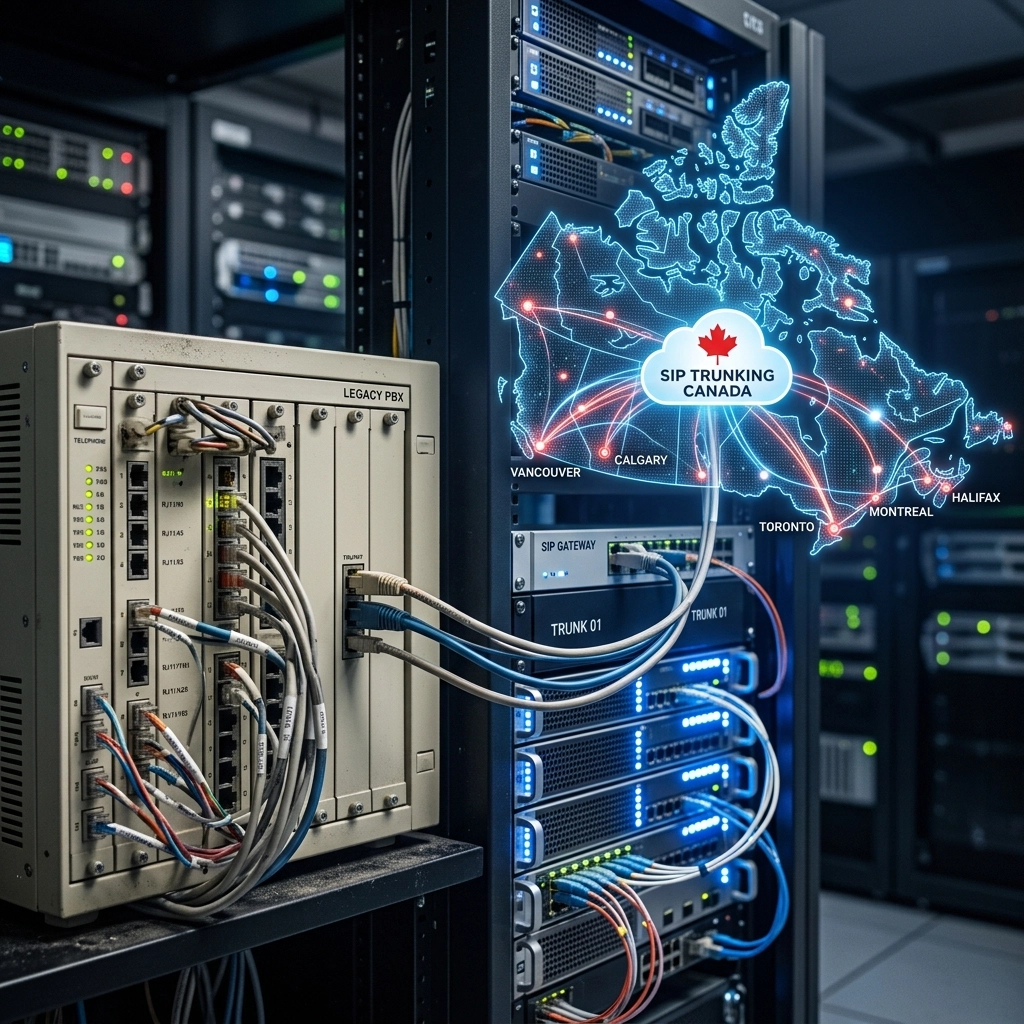
The good news is that you don't have to throw away your hardware to enjoy modern features. SIP Trunking is the bridge that allows your legacy PBX system to communicate over the internet, providing the benefits of business voip canada without the massive capital expenditure of a total hardware replacement.
What is SIP Trunking and Why Does it Matter?
SIP, or Session Initiation Protocol, is the industry standard for starting, managing, and ending voice and video calls over the internet. A "trunk" is a virtual version of an old-school bundle of wires. Instead of physical lines coming from the phone company into your building, a SIP trunk is a digital connection that uses your internet service.
For businesses currently using an on-premise PBX (Private Branch Exchange), SIP trunking acts as the engine upgrade for your existing vehicle. It allows you to keep your desk phones and your main control unit while replacing the expensive, rigid "copper" lines with a flexible, high-speed data connection.

The Problem: The High Cost of Hanging On
Traditional phone lines are becoming a liability for Canadian businesses. Major carriers across the country are slowly phasing out legacy infrastructure, which leads to rising monthly costs and slower repair times for analog lines.
If you are running a legacy system, you likely face three major hurdles:
- Inflexible Scaling: If you hire two new people, you might have to wait weeks for a technician to install new physical lines.
- Geographic Limitations: Your phone numbers are tied to a specific physical exchange, making it difficult to expand or move offices.
- High Long-Distance Fees: Traditional carriers still charge significant premiums for calls outside your immediate area code.
The Solution: SIP Trunking for Legacy Systems
By switching to SIP trunking, you solve these problems while retaining your initial hardware investment. It is the most cost-effective way to modernize. You gain the power of a cloud pbx canada while keeping the physical hardware you already trust.
1. Significant Cost Reduction
On average, Canadian businesses see a 30% to 50% reduction in their monthly communication bills after switching to SIP. You no longer pay for "extra" lines you don't use; you only pay for the capacity you actually need.
2. Business Continuity and Failover
In the past, if a backhoe cut the phone line outside your office, your business went dark. With SIP trunking, you can configure automatic failover. If your office internet goes down, calls can be instantly routed to mobile phones or a secondary location.
3. Number Portability and Local Presence
SIP trunking allows you to keep your existing Canadian numbers regardless of where your office is located. You can also add "local" numbers in Vancouver, Toronto, or Halifax to give your business a local feel across the country, all ringing into your central legacy PBX.

How to Connect Legacy Hardware to a SIP Trunk
You might be wondering: "How does my 15-year-old Nortel or Avaya box talk to the internet?" The answer lies in a small but powerful piece of hardware called a VoIP Gateway or an ATA (Analog Telephone Adapter).
The Role of the VoIP Gateway
A VoIP Gateway acts as a translator. On one side, it plugs into your legacy PBX using traditional ports (like PRI, T1, or FXO/FXS). On the other side, it plugs into your internet router. It takes the analog or digital signals from your PBX and converts them into "packets" for the internet.
This setup allows your staff to continue using their existing handsets exactly as they do today. There is no learning curve and no need for extensive staff retraining.
The Importance of Structured Cabling
To ensure this transition works flawlessly, your physical environment must be ready. This is where structured cabling services become vital. Even though your PBX is old, the connection between your gateway and your router needs to be high-quality.
Old, messy wiring in your server room can lead to "jitter" or dropped packets, which results in poor call quality. A professional audit of your cabling ensures that your new SIP connection has a "clean" path to the outside world.

Technical Requirements for Success in Canada
Implementing SIP trunking in Canada requires attention to a few specific technical details to ensure the "crystal clear" quality that Voiswitch is known for.
Bandwidth and Quality of Service (QoS)
Voice data is lightweight, but it is extremely sensitive to timing. If a large file download starts at the same time as a phone call, the voice call might stutter. To prevent this, your router must be configured for Quality of Service (QoS), which gives voice traffic the "VIP lane" on your internet connection.
STIR/SHAKEN Compliance
In Canada, the CRTC has mandated the STIR/SHAKEN framework to combat caller ID spoofing and spam calls. When choosing a provider, ensure they are fully compliant with Canadian regulations. This ensures that your outbound calls aren't mistakenly flagged as "Spam" by the people you are trying to reach.
Emergency Services (E911)
Legacy lines automatically provide location data to emergency responders. With SIP, your location is "virtual." You must work with your provider to ensure your physical address is correctly registered so that 911 calls from your legacy hardware reach the correct Canadian emergency dispatch.

Step-by-Step Implementation Guide
If you're ready to make the switch, follow this logical progression to ensure a smooth transition:
- Audit Your Current Usage: Look at your peak call volume. How many people are on the phone at the exact same time? This determines how many SIP "channels" you need.
- Test Your Internet Connection: Use a professional tool to measure latency and jitter. High-speed residential internet is often not enough; a dedicated business line is recommended for enterprise phone systems.
- Choose the Right Gateway: Match the ports on your PBX. If you have a PRI (Primary Rate Interface) card, you need a PRI-to-SIP gateway.
- Configure a Firewall: Security is paramount. Ensure your firewall is set up to allow SIP traffic while blocking unauthorized access to your PBX.
- Pilot Program: Start by routing a few non-essential numbers over the SIP trunk before porting your main corporate number.
Comparing the Paths: SIP Trunking vs. Cloud PBX
Is SIP trunking always the right choice? Not necessarily. It depends on your current situation and long-term goals.
- Choose SIP Trunking if: You have a significant investment in physical hardware, your staff is comfortable with their current phones, and you want to lower monthly costs immediately without a large upfront purchase.
- Choose Cloud PBX if: Your hardware is failing, you have a high percentage of remote workers, or you want to eliminate the server room altogether. For a deeper dive, check out our guide on SIP Trunking vs Cloud PBX.

Conclusion: Future-Proofing Without the Headaches
Modernizing your business communication doesn't have to be a "scorched earth" project. By utilizing SIP Trunking, you can extract every last bit of value from your legacy hardware while gaining the flexibility and cost-savings of the cloud.
The transition from traditional lines to SIP is a strategic move that removes the liability of aging copper infrastructure. It allows your business to scale effortlessly, stay connected during outages, and enjoy the reliability that modern Canadian businesses demand.
If you are unsure where to start with your hardware configuration or if your current structured cabling services are up to the task, reaching out to an expert can save you hours of troubleshooting. At Voiswitch, we specialize in making the "old" talk to the "new" seamlessly.
Modern communication is about removing barriers. Don't let your legacy hardware be a barrier: let it be the foundation for your next step into the world of VoIP.