For many Canadian business owners, expanding to a second, third, or tenth location is a major milestone. It signifies growth and success. However, it often brings an unexpected technical headache: managing a fragmented communication network.
If your "head office" uses one phone system, your Vancouver branch uses another, and your remote sales team relies on their personal cell phones, you aren't just losing money, you’re losing control. Managing remote branches shouldn't feel like managing separate companies.
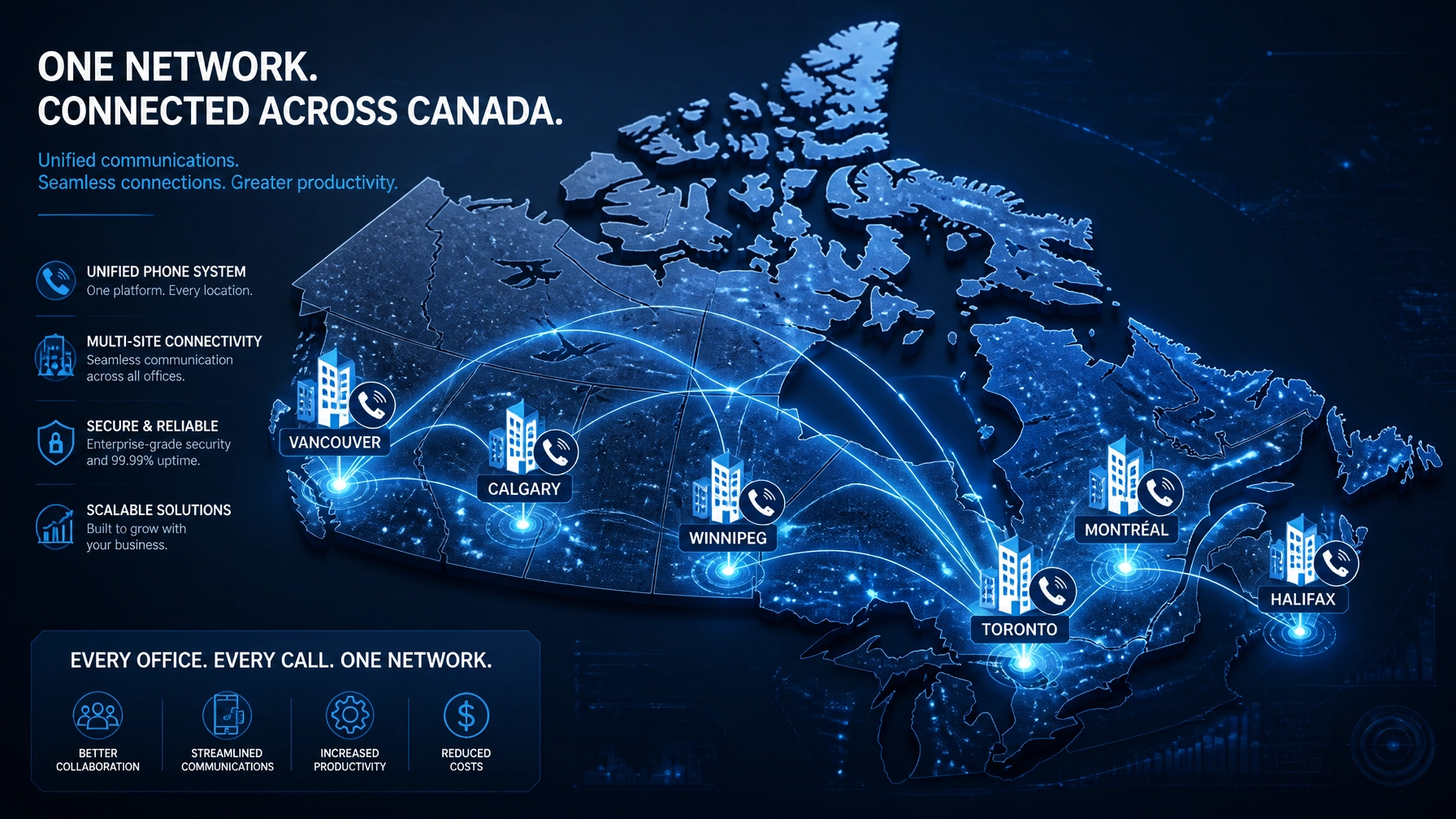
Modern enterprise phone systems, particularly those built on Cloud PBX Canada infrastructure, have redefined how multi-site organizations operate. By centralizing your communications, you can treat every employee, whether they are in a high-rise in Toronto or a home office in Halifax, as if they were sitting at the desk next to yours.
The Problem: The Legacy Fragmentation Trap
In the past, opening a new branch meant buying a new hardware PBX, installing dedicated phone lines (PRIs or copper), and hiring a local technician for the setup. This approach created "communication silos."
When each office has its own independent system, simple tasks become complicated. You cannot easily transfer a call from the Calgary office to the Montreal branch. You cannot see if a colleague in another city is currently on a call. Furthermore, you end up paying for separate maintenance contracts and service providers for every single location.
This legacy model is not only expensive; it’s a liability. If the hardware at one branch fails, that entire office goes dark until a technician can arrive on-site. For a growing business, this lack of agility is a significant bottleneck.
What Is a Modern Enterprise Phone System?
An enterprise phone system is a unified communication platform that connects all your locations into a single, cohesive network. Unlike traditional systems that live in a closet at your office, modern systems are hosted in the cloud.
With business VoIP Canada services, your "phone system" is no longer a physical box, it is a secure, digital platform accessible via the internet. This shift from hardware to software changes everything about how you manage remote branches.

1. Centralized Management: One Portal to Rule Them All
The biggest game-changer for branch management is the ability to control everything from a single web-based portal. In a legacy setup, adding a new user in a remote branch required a physical visit or a remote login to a specific piece of hardware.
With a Cloud PBX, your IT manager (or your service provider) can:
- Provision new extensions in seconds: Whether you’re hiring one person in Regina or ten people in a new Ottawa office, you can set up their phones from your central dashboard.
- Update call routing instantly: If an office needs to close early due to weather, you can reroute those calls to another branch or an auto-attendant with three clicks.
- Monitor performance across the board: Access real-time analytics for every branch to see call volumes, wait times, and missed calls without needing to ask for local reports.
2. Eliminating Inter-Site Costs
If your branches are on separate systems, calling between them often counts as a long-distance call or, at the very least, ties up your external phone lines.
Enterprise VoIP systems treat every branch as part of the same internal network. Calling from the Vancouver branch to the Toronto headquarters is an "extension-to-extension" call. It is free, it stays within your private network, and it doesn't use up any of your external lines. For businesses with high internal collaboration, this alone can save thousands of dollars annually.
3. Unified Brand Experience
Consistency is key to professional branding. When a customer calls your company, they should have the same experience regardless of which branch they reach.
With a unified enterprise system, you can implement a global "Auto-Attendant." A customer calls your main number and hears: "Press 1 for Sales, 2 for Support, or 3 for our Calgary branch." If Sales is busy in Toronto, the call can automatically roll over to a representative in Winnipeg. The customer never knows they’ve been transferred across the country, they just know their call was answered promptly.
4. Hardware Flexibility and Remote Work
Managing remote branches isn't just about physical offices anymore; it’s about remote and hybrid workers. Modern enterprise systems aren't tied to a desk.

Employees can stay connected using:
- Physical IP Phones: High-quality desk phones that plug into any internet connection and immediately register as their specific extension.
- Softphones: Applications on laptops or desktop computers that act as a full-featured business phone.
- Mobile Apps: Business apps for smartphones that allow employees to make and receive calls using their business number, keeping their personal cell number private.
This flexibility means that if you need to move a branch or allow a team to work from home, the "move" involves nothing more than unplugging a phone and plugging it in at a new location.
The Role of Infrastructure: Don't Forget the Cables
While the "brain" of the system is in the cloud, the "nervous system" is in your walls. A common mistake when setting up remote branches is neglecting the physical infrastructure.
To ensure high-quality voice and data, your branches need professional structured cabling services. VoIP is sensitive to network "jitter" and "latency." If your branch is running on old, messy wiring or consumer-grade Wi-Fi, your expensive phone system will perform poorly.
Investing in organized, high-speed business internet and professional networking ensures that your voice calls are crystal clear, regardless of how many people are using the internet at that location.

Comparison: Legacy PBX vs. Enterprise Cloud PBX
| Feature | Legacy Multi-Site PBX | Enterprise Cloud PBX |
|---|---|---|
| Upfront Cost | High (Hardware per site) | Low (Phones & Setup only) |
| Maintenance | Local technician required | Managed remotely by provider |
| Scaling | Slow (Order lines/hardware) | Instant (Add users in portal) |
| Inter-site Calls | Often charged as long distance | Free (Internal extensions) |
| Disaster Recovery | Difficult (Site-dependent) | Automatic (Reroute to mobile/other site) |
| Management | Fragmented & Manual | Centralized Web Portal |
Scalability: Growing Without Growing Pains
Perhaps the most significant benefit for Canadian businesses is the ability to scale. In a traditional environment, if you want to open a small satellite office with only two people, the cost of a phone system and SIP trunks might be prohibitively high.
With an enterprise Cloud PBX model, you simply add two more users to your existing plan. You ship two IP phones to the new location, they plug them in, and they are online. This "pay-as-you-grow" model allows small businesses to act like large corporations and large corporations to remain as agile as startups.
Why Voiswitch is the Partner for Your Multi-Site Business
At Voiswitch, we understand that Canadian businesses face unique geographical challenges. Managing a team across different time zones and provinces requires more than just "a phone line", it requires a strategy.
We provide end-to-end communication solutions, from the structured cabling in your new office to the Cloud PBX that unifies your team. Our award-winning 24/7 customer support means that if a branch in Vancouver has a question at 6:00 AM local time, we are awake and ready to help.
We don't just sell you hardware; we help you design a system that removes the headaches of remote management, reduces your monthly liabilities, and allows your team to focus on what they do best.
Conclusion: Stop Managing Systems, Start Managing Your Business
The shift to an enterprise phone system is about more than just technology, it’s about operational freedom. By moving to a centralized, cloud-based platform, you eliminate the technical silos that slow down your growth. You gain visibility into your entire organization, reduce your overhead, and provide your employees with the modern tools they need to succeed.
If you are currently struggling with fragmented systems or planning a new branch expansion, now is the time to look at a unified solution.
Ready to unify your branches? Contact Voiswitch today for a consultation and see how our enterprise solutions can transform your business communications.
Frequently Asked Questions
1. Can I keep my existing phone numbers if I switch to an enterprise VoIP system?
Yes. You can port your existing Canadian phone numbers from any provider to Voiswitch. This includes local numbers for different cities, ensuring you maintain your local presence.
2. What happens if the internet goes down at one of my branches?
Because the system is hosted in the cloud, the "system" never goes down. If a specific branch loses internet, calls can be automatically rerouted to employees' mobile apps or to another branch that is still online.
3. Do I need to buy all new phones for every branch?
Not necessarily. If you already have modern IP phones, we can often reconfigure them to work with our system. If you have older analog phones, we can provide adapters or help you upgrade to modern hardware that supports the full feature set.
4. Is it difficult to manage the system if I’m not a "tech person"?
Our web portal is designed for business owners and managers, not just IT experts. It is intuitive and straightforward. Furthermore, Voiswitch provides 24/7 support to handle any complex changes you might need.