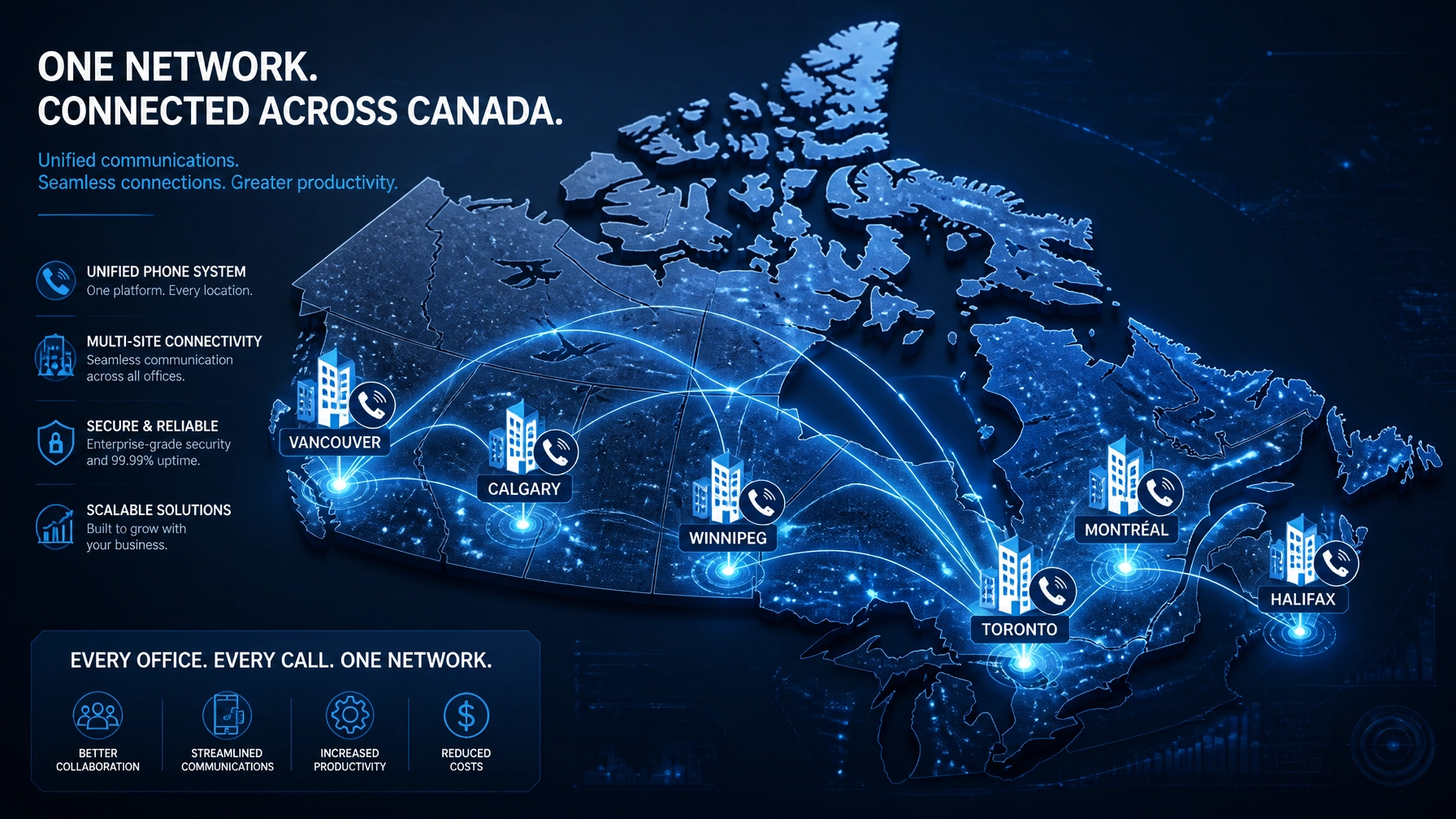
For decades, Canadian enterprises operating across multiple locations faced a significant hurdle: communication silos. Managing an office in Toronto, a warehouse in Calgary, and a sales hub in Montreal often meant juggling three separate phone systems, three different service contracts, and a mountain of IT headaches. These "island" systems didn't talk to each other, making simple tasks like transferring a call or checking an employee's availability across branches nearly impossible.
As the business landscape shifts toward hybrid work and rapid expansion, these legacy constraints are no longer just an inconvenience, they are a liability. Today, modern enterprise phone systems, specifically cloud PBX Canada solutions, have transformed from a "nice-to-have" upgrade into a strategic necessity. By centralizing communication into a single, unified platform, businesses can finally operate as one cohesive unit, regardless of geography.
The Problem: The High Cost of Fragmented Legacy Systems
Before we look at the solution, it is important to understand why the traditional approach to multi-site management is failing. In a legacy environment, each office typically houses its own on-premise PBX (Private Branch Exchange) hardware. This creates several critical points of friction:
- Operational Inefficiency: If you need to change a greeting or add a new extension in the Vancouver office, your IT team might need to log in to a completely different interface or even travel to the site physically.
- High Long-Distance Costs: Even though the calls are internal, moving a call from one branch's legacy system to another often incurs standard long-distance charges because the systems utilize the public switched telephone network (PSTN) to connect.
- Maintenance Nightmares: When hardware fails at a satellite location, the downtime can last days while waiting for a specialized technician or a replacement part.
- Inconsistent Customer Experience: Customers calling different branches may encounter different hold music, varying auto-attendant menus, and an inability to be transferred to the right expert if that person happens to be at another location.
These challenges are why many growing organizations are searching for a better way to manage their business voip canada needs.

Why Cloud PBX is the Unified Solution for Multi-Site Management
The shift to a modern enterprise phone system replaces physical hardware with a software-driven, hosted environment. Instead of managing "boxes" at every location, you manage a single service in the cloud. This change in architecture fundamentally alters how a multi-site business functions.
Centralized Management: The "Single Pane of Glass"
The most immediate benefit of a modern system is centralized administration. Through a single web-based portal, an administrator can manage every user, extension, and call flow across the entire organization.
Whether you are onboarding ten new employees in Halifax or adjusting the holiday hours for your retail locations in Ontario, the changes are made instantly from one location. This level of control removes the need for local IT presence at every branch and ensures that company-wide policies are enforced consistently. For a deeper dive into how this scales, see our ultimate guide to enterprise phone systems for multi-site management.
Seamless Connectivity and Presence
In a modern enterprise system, every employee is part of the same virtual network. This enables features that were previously impossible or cost-prohibitive:
- Universal Extension Dialing: An employee in Ottawa can reach a colleague in Edmonton by simply dialing a four-digit extension.
- Presence Indicators: Before transferring a call, a receptionist can see if a manager at another branch is currently on a call, in a meeting, or available.
- Unified Messaging: Voicemails are delivered to email, and call logs are centralized, providing a clear audit trail of communication across the company.
Slashing Operational Costs and CAPEX
Managing multiple offices is expensive, but your phone system shouldn't be the primary driver of those costs. Traditional systems require heavy capital expenditure (CAPEX) for hardware at each site. In contrast, modern cloud PBX Canada operates on an operating expenditure (OPEX) model.
By eliminating the need for expensive on-site PBX servers, businesses save on:
- Hardware Costs: No more buying and housing bulky servers at every branch.
- Space and Power: Reclaim your server room space and reduce energy consumption.
- Maintenance Contracts: You no longer need separate maintenance agreements for different hardware versions across sites.
- Inter-Office Calling: Because calls between branches travel over the internet, they are typically free of charge, significantly reducing monthly recurring costs.
If you're wondering if your current scaling strategy justifies this move, read our analysis on hosted PBX systems for scaling Canadian businesses.

The Foundation: Structured Cabling and Networking
While the "brain" of the phone system lives in the cloud, the "nerves" are still physical. For a multi-site enterprise to enjoy crystal-clear voice quality, the underlying infrastructure must be robust. This is where structured cabling services and professional networking come into play.
A common mistake businesses make is upgrading their software without addressing their physical network. High-quality VoIP requires a stable, high-speed connection and a local network that can prioritize voice traffic over data traffic (Quality of Service, or QoS).
Key Infrastructure Requirements:
- Category 6 (Cat6) Cabling: To ensure your IP phones have the bandwidth they need, modern structured cabling is essential.
- Power over Ethernet (PoE) Switches: This allows your phones to receive power and data through a single cable, simplifying the setup and reducing clutter.
- Business-Grade Internet: Relying on consumer-grade internet is a recipe for dropped calls. Multi-site businesses should look for providers offering dedicated fiber or high-speed business internet. You can compare options in our guide to choosing the best business internet providers in Canada.

Reliability and Disaster Recovery in a Multi-Site Context
One of the greatest risks for a multi-site business is a local outage. If a storm knocks out the phone lines at your Toronto headquarters, does your entire company go dark?
With a legacy system, the answer is often "yes." With a modern enterprise phone system, the answer is a resounding "no." Because the system is hosted in the cloud, it is not tied to a physical location. If one office loses power or internet, calls can be instantly rerouted to:
- Another branch location.
- Employees' mobile devices via a mobile app.
- An automated greeting or a professional call center.
This level of resiliency ensures that your business stays reachable, maintaining your professional reputation even in the face of local disasters. If you find your current call quality is lacking, check out these 10 reasons for call quality drops and how to fix them.
Future-Proofing for the Hybrid Workforce
The way we work has changed. Modern enterprise phone systems don't just connect offices; they connect people. Whether an employee is at their desk in the office or working from a home office in the suburbs, they use the same business number, the same extension, and the same features.
This flexibility is vital for multi-site managers who need to hire the best talent regardless of where they live. By providing a unified platform, you remove the "headache" of managing remote worker communication and replace it with a seamless, professional experience for both employees and customers.

Conclusion: The Voiswitch Advantage
Managing communication across multiple sites shouldn't be a source of stress. By moving to a modern enterprise phone system, you eliminate the technical silos that slow down your business and drive up your costs.
At Voiswitch, we specialize in helping Canadian businesses bridge the gap between their locations. From providing award-winning business voip canada services to executing professional structured cabling services, we provide the end-to-end support you need to thrive. We don't just sell you a service; we partner with you to design a communication strategy that removes your operational liabilities and prepares you for the future of work.
Ready to unify your offices? Contact Voiswitch today for a consultation and discover how a modern cloud PBX can change the way you manage your enterprise.