For Canadian business owners, the decision to upgrade a communication system often comes down to one question: Will this system still work for me in three years? As the legacy copper-wire networks are phased out across the country, businesses are moving to the cloud at an unprecedented rate. However, not all cloud solutions are created equal.
The choice between a standard small business VoIP setup and a robust enterprise-grade phone system is a critical fork in the road. While both leverage Voice over Internet Protocol (VoIP) technology, they serve different operational scales and growth trajectories. Choosing the wrong one can lead to "growing pains": either paying for features you don't use or hitting a technical ceiling just as your business begins to scale.
What is the Difference Between SMB VoIP and Enterprise Systems?
At its core, Small Business VoIP is designed for agility and simplicity. These systems are typically hosted in the cloud and offer essential features like auto-attendants, voicemail-to-email, and mobile apps. They are perfect for small teams: from family-run shops to boutique agencies: who need a professional image without the complexity of traditional hardware.
On the other hand, Enterprise Phone Systems (often referred to as Enterprise Cloud PBX) are built for complexity and high-volume operations. These systems are designed to support hundreds or thousands of users across multiple branches. They offer deeper integrations with CRMs like Salesforce, advanced call center functionalities, and strict Service Level Agreements (SLAs) that guarantee 99.999% uptime.
Comparing the Core Features
| Feature | Small Business VoIP | Enterprise Phone Systems |
|---|---|---|
| Scalability | Easy to add individual lines | Built for rapid, bulk expansion across multiple sites |
| Integrations | Basic (Email, standard CRM) | Deep (Enterprise CRM, ERP, Custom APIs) |
| Support | Standard business hours | 24/7 Priority Support & Managed Services |
| Control | Simple web portal | Granular, role-based administration |
| Compliance | Standard Security | PIPEDA, SOC2, and Industry-specific compliance |
Scaling for Success: Is Your System Holding You Back?
Growth isn't just about adding more employees; it’s about increasing efficiency. A small business system might work perfectly when you have five employees, but what happens when you open a second office in Vancouver or a third in Halifax?
Enterprise systems thrive in multi-location environments. Through Cloud PBX solutions, a company can manage all branches from a single interface, ensuring a unified customer experience. If a call comes in for a specialist in Toronto but the line is busy, the system can automatically route the call to an available agent in Calgary without the customer ever knowing.

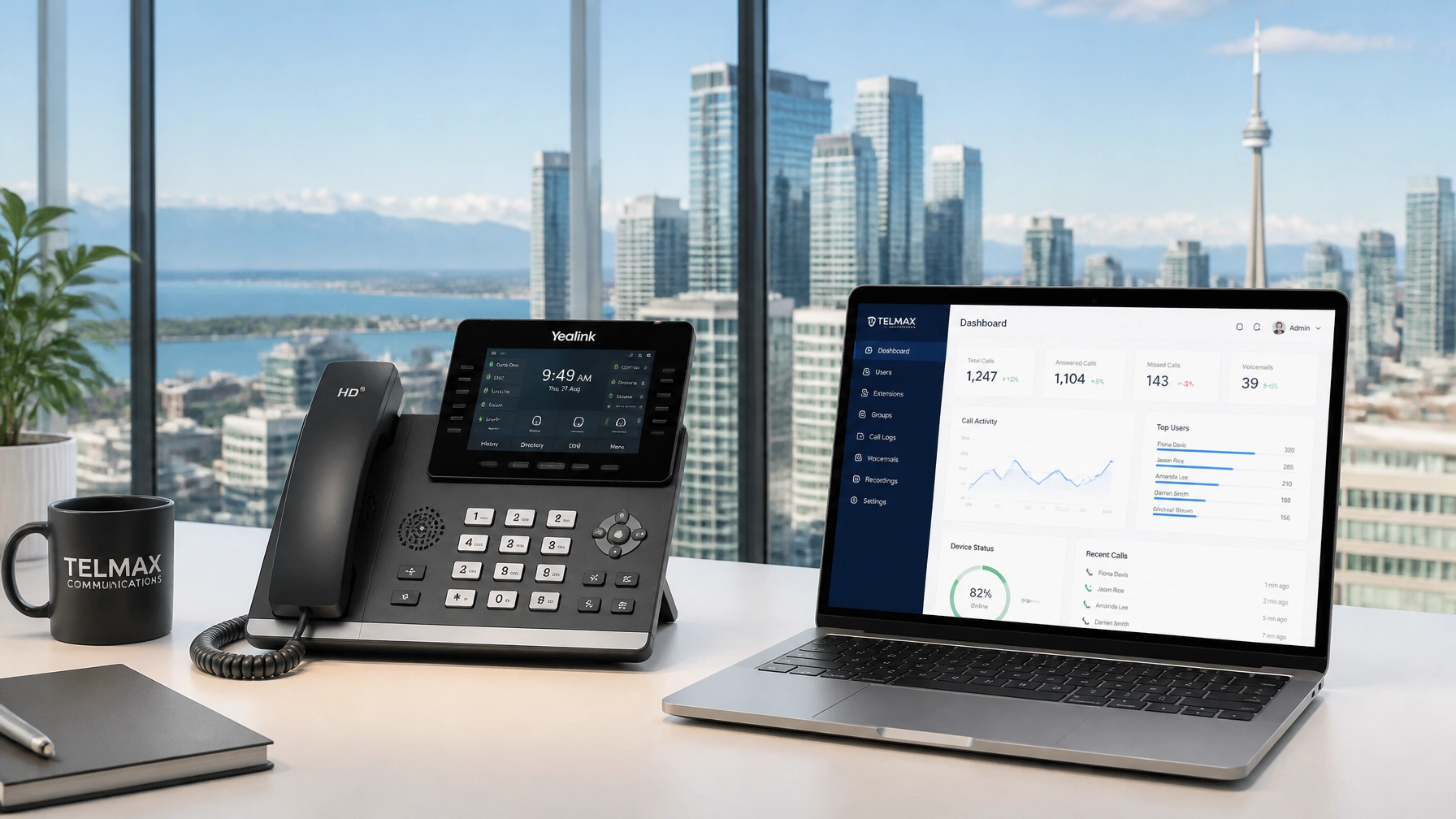
Note: This image represents the centralized control found in enterprise-grade cloud systems.
The Role of Reliability and Canadian Infrastructure
In Canada, geography matters. Whether you are operating in a dense urban center or a more remote region, your business internet is the lifeline of your phone system.
Enterprise systems often utilize SIP Trunks to bridge the gap between legacy infrastructure and modern cloud benefits. By using SIP Trunks, larger organizations can keep their existing on-premise PBX hardware while gaining the cost-savings and flexibility of VoIP. This is particularly useful for Canadian enterprises that have invested heavily in local hardware but want to modernize their connectivity.
Why Quality of Service (QoS) Matters
Small business VoIP can sometimes suffer from jitter or dropped calls if the office internet is also being used for heavy data transfers. Enterprise-grade setups often include managed networking and structured cabling services to ensure voice traffic is prioritized. This ensures that a large download in the accounting department doesn't ruin a high-stakes sales call in the boardroom.
Hardware Considerations: Choosing the Right Tools
The "phone" in your phone system is still the primary touchpoint for many employees. While many SMBs rely on "softphones" (apps on a computer or mobile), growing enterprises often prefer dedicated hardware for desk-based roles.
At Voiswitch, we see a clear trend in hardware preference:
- Small Businesses: Often lean towards versatile, budget-friendly models like the Grandstream IP phones.
- Enterprises: Frequently invest in high-end video phones and expansion modules to handle complex executive and receptionist needs.

Compliance and Security in the Canadian Landscape
For Canadian businesses, data residency and privacy laws (like PIPEDA) are non-negotiable. Enterprise phone systems are built with these regulations in mind. They offer encrypted calling, secure data centers within Canadian borders, and detailed audit logs.
Small business VoIP providers generally offer good security, but they may lack the granular permissions required by larger HR departments. For example, an enterprise system allows you to restrict who can record calls, who can access voicemails, and who can see call history at a departmental level.
Cost vs. Value: The Long-Term Perspective
Initially, a small business VoIP plan looks more attractive because of the low per-user monthly cost. However, as you grow, the "hidden costs" of a basic system can add up:
- Productivity Loss: If your system doesn't integrate with your CRM, your team wastes hours on manual data entry.
- Maintenance Headaches: Managing 50 separate "small business" accounts is a nightmare compared to one unified enterprise account.
- Downtime: For a large company, even an hour of downtime can cost thousands in lost revenue. Enterprise SLAs mitigate this risk.
Investing in a robust system early on: or choosing a provider like Voiswitch that allows you to scale from a small plan into an enterprise solution seamlessly: is the most cost-effective path for growth.

Making the Choice: Which is Right for You?
Choose Small Business VoIP If:
- You have fewer than 20-30 employees.
- You need a system that can be set up in minutes.
- Your team is mostly remote and uses mobile apps for calls.
- You want a fixed, predictable monthly cost with no hardware investment.
Choose Enterprise Phone Systems If:
- You have multiple locations or plans to expand rapidly.
- You require deep integration with professional software suites.
- You handle high call volumes (e.g., a customer support center).
- You need the highest possible reliability and 24/7 technical support.
Conclusion
The "better" system is the one that removes friction from your daily operations. For a startup, that might be a simple, agile VoIP app. For an established corporation, it’s a redundant, feature-rich Cloud PBX.
At Voiswitch, we specialize in helping Canadian businesses navigate this transition. Whether you are looking for your first professional IP phone or need a complete structured cabling overhaul for a new headquarters, our team provides the end-to-end support you need to grow without boundaries.
Ready to future-proof your business communications? Contact Voiswitch today for a customized consultation tailored to your growth goals.