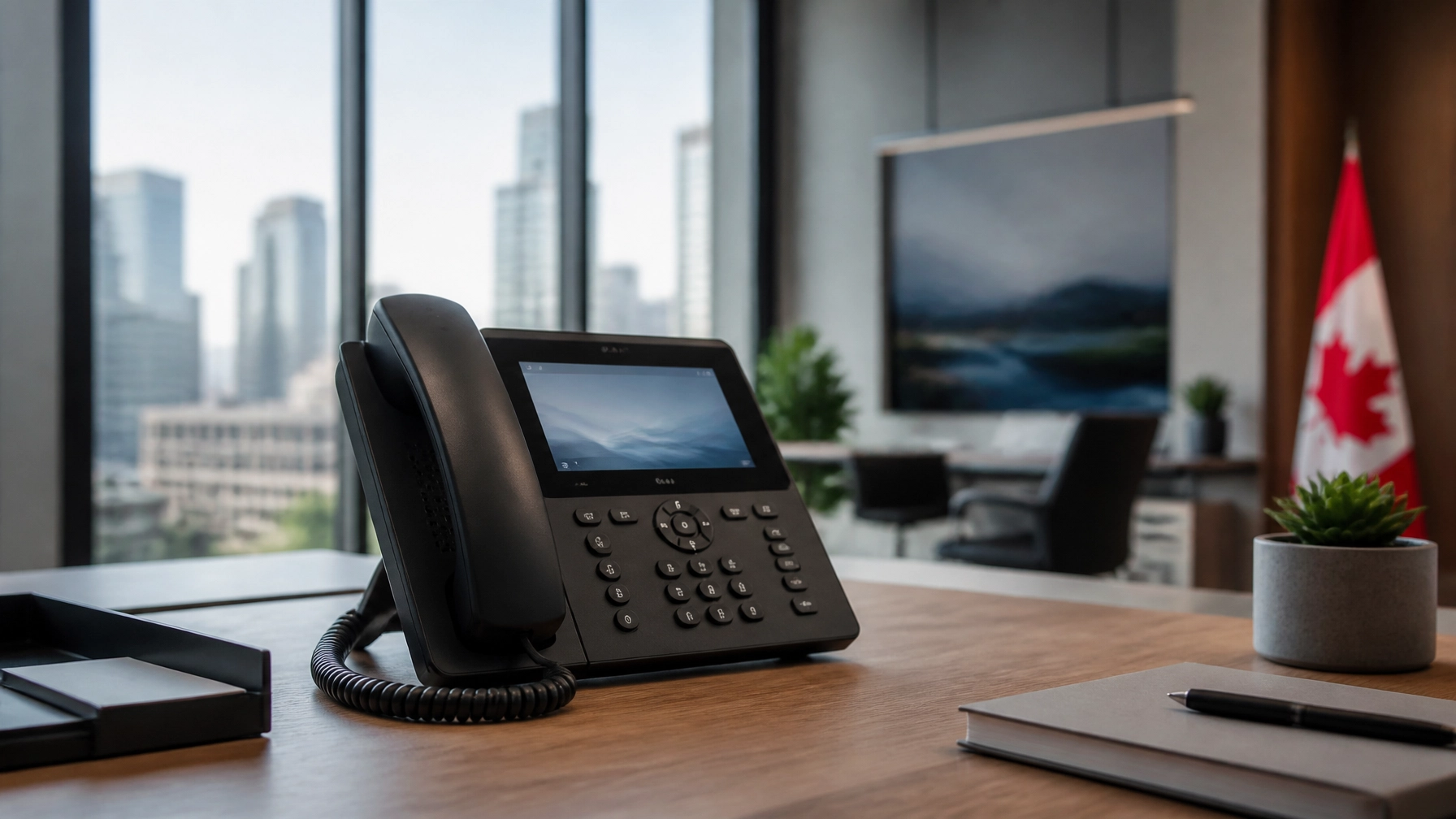
For years, Canadian business owners believed that a "real" phone system required a massive closet full of wires, expensive hardware, and a dedicated technician on speed dial. This was the era of the traditional enterprise phone system, a reliable but rigid and costly beast. If you wanted the features the big banks had, like auto-attendants or call queuing, you had to pay a premium.
Fast forward to today, and the landscape has shifted. The rise of Cloud PBX Canada solutions has leveled the playing field. Small businesses in Toronto, Vancouver, and everywhere in between can now access enterprise-grade features at a fraction of the cost. But is the "old way" ever the "better way"?
In this guide, we’ll break down the differences between traditional enterprise phone systems and modern VoIP to see which one truly protects your bottom line.
What Is a Traditional Enterprise Phone System?
When we talk about traditional enterprise systems, we are usually referring to on-premise PBX (Private Branch Exchange). These systems connect to the Public Switched Telephone Network (PSTN) via physical copper wires or specialized digital lines like PRI (Primary Rate Interface).
The hardware lives in your office. It’s a physical box, often the size of a microwave, mounted on a wall or tucked into a server rack. While these systems are incredibly stable, they are also incredibly "heavy" in terms of capital expenditure and maintenance.
What Is Business VoIP Canada?
VoIP, or Voice over Internet Protocol, turns your voice into data packets that travel over the internet. Instead of a physical box in your closet, the "brains" of your phone system live in a secure data center, this is why it’s often called a Cloud PBX.
For a small business in Canada, business VoIP Canada means your phones connect to your office router instead of a wall jack. You can use physical IP phones, computer softphones, or even mobile apps to take business calls anywhere you have an internet connection.
The Cost Comparison: Upfront vs. Ongoing
The biggest factor for most Canadian SMBs is the "Bottom Line." Let’s look at the numbers.
1. Initial Investment (CapEx)
- Enterprise PBX: You have to buy the server, the line cards, the proprietary handsets, and pay for professional installation. This can easily run between $3,000 and $10,000 for a small office.
- VoIP: Your primary cost is the hardware (like Grandstream IP phones) and perhaps a one-time activation fee. If you choose to use softphones, your upfront cost could be $0.

2. Monthly Service Fees (OpEx)
- Enterprise PBX: You pay for individual "trunk lines" from a traditional telco. These often cost $50–$100 per line/month. Long-distance charges are usually extra and can be pricey.
- VoIP: Most providers offer flat-rate per-user pricing, typically ranging from $15 to $40 per month. This usually includes unlimited North American calling, significantly reducing monthly overhead.
3. Maintenance and Upgrades
With a traditional system, if you want a new feature or need a repair, you have to pay a technician to visit your site. With a Cloud PBX Canada solution, updates happen automatically in the cloud. There are no "maintenance contracts" because there is no hardware on-site to break.

Does the Infrastructure Matter?
One common "headache" for businesses moving to a modern system is the state of their wiring. Traditional phones used old-school telephone wire (RJ11). Modern VoIP and IP PBX systems require high-speed data cabling (Cat5e or Cat6).
This is where structured cabling services become essential. If your office still has 20-year-old wiring, your "modern" phone system will only be as reliable as the cables it's plugged into. Professional structured cabling ensures that your voice data doesn't compete with your Netflix-streaming coworkers, preventing dropped calls and "jitter."

Features: Enterprise Power for Small Teams
In the past, if a small family-run retail shop wanted a professional "Press 1 for Sales" menu, it required a massive investment. Today, VoIP includes these "Enterprise" features as standard:
- Auto-Attendant: A digital receptionist to route calls.
- Ring Groups: Make multiple phones ring at once (e.g., everyone in the service department).
- Voicemail-to-Email: Read your messages in your inbox instead of dialing in.
- Mobile Integration: Use your office number on your personal smartphone via an app.
This mobility is a game-changer. Whether you’re working from a home office in Mississauga or meeting a client in Calgary, you never miss a call.

The Decision: Which Is Better for You?
Choose a Traditional Enterprise System if:
- You already have the hardware and it’s fully paid off.
- You have extremely unreliable internet and cannot upgrade it.
- You have very specific security requirements that mandate "air-gapped" on-premise hardware.
Choose VoIP for Small Business if:
- You want to save money: Most businesses see a 30–60% reduction in their monthly bill.
- You are growing: Adding a new employee is as simple as ordering a new IP phone and clicking a button in a dashboard.
- You have remote workers: Your team can work from anywhere without complex VPNs.
- You want a professional image: Get the same high-end features as a Fortune 500 company.
Why Voiswitch?
Transitioning from a legacy system can feel overwhelming. At Voiswitch, we don't just sell you a service and walk away. We provide an end-to-end communication solution. From the initial structured cabling services and network optimization to the installation of high-quality video phones and 24/7 ongoing support, we handle the technical "headaches" so you can focus on your business.
The "Bottom Line" isn't just about the monthly bill: it's about the time you save and the reliability you gain. For most Canadian small businesses, the shift to VoIP is no longer a luxury; it’s a competitive necessity.
Ready to modernize your business communications? Contact Voiswitch today for a customized quote that fits your budget.