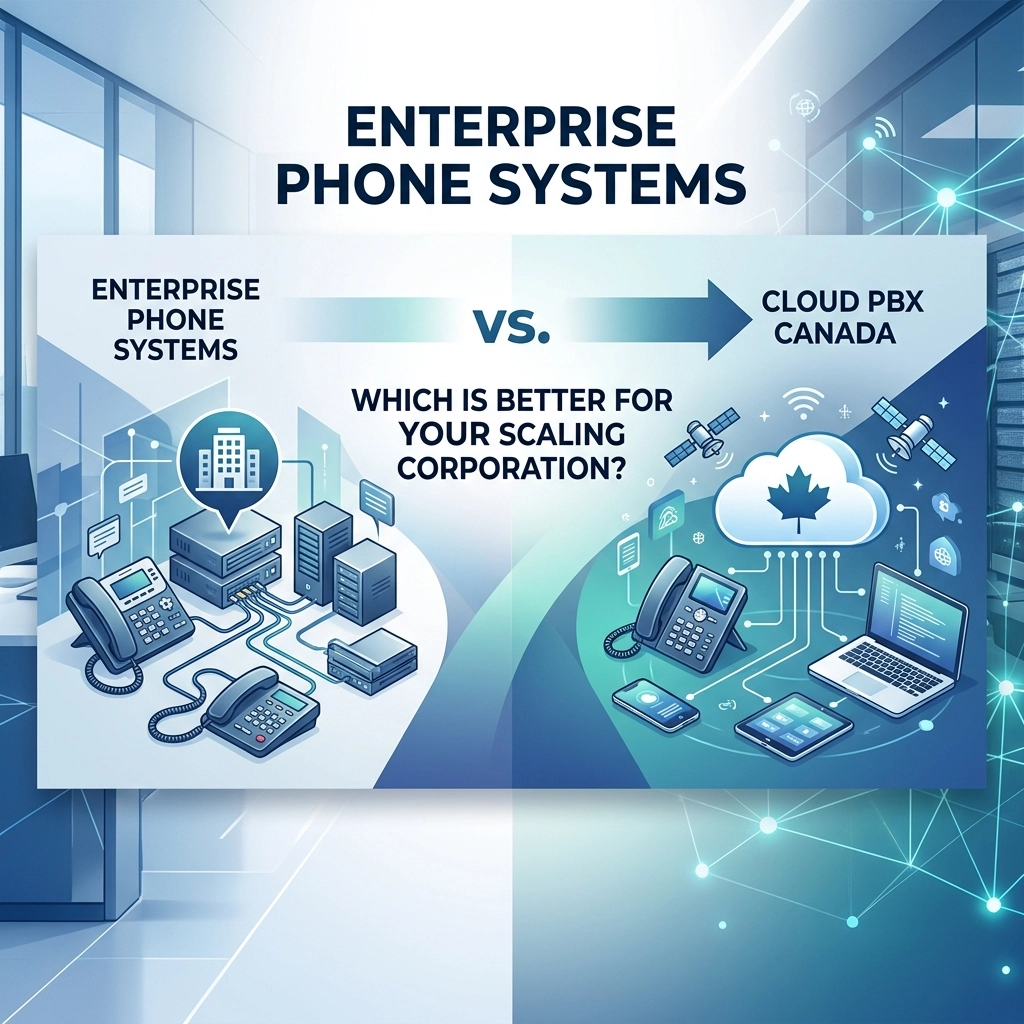
For many Canadian business owners, the server room is a place of significant investment. You see the racks, the blinking lights of your IP-PBX, and the rows of high-quality desk phones. However, the telecommunications landscape is shifting. Legacy PSTN lines are being phased out, and the push toward digital transformation is stronger than ever.
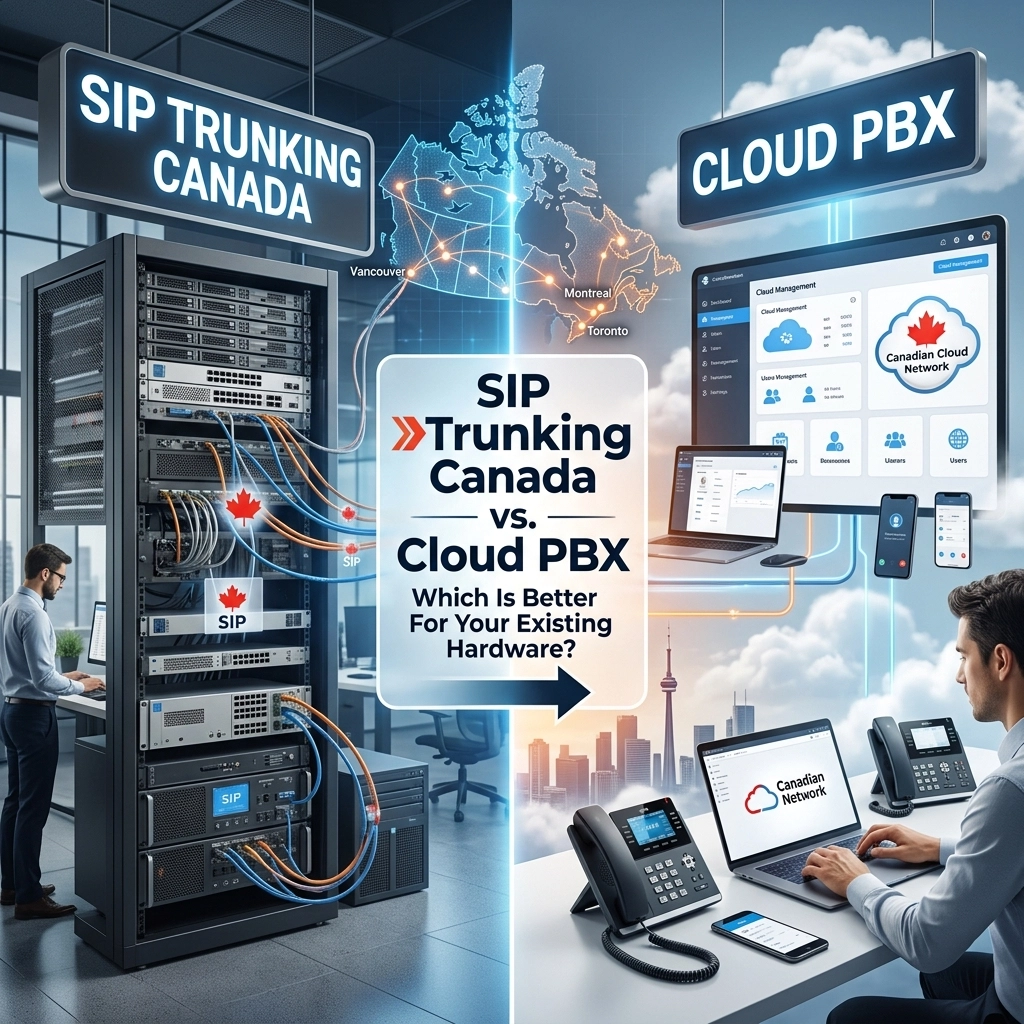
The dilemma is simple: do you leverage the hardware you already own, or do you move everything to the cloud? This decision often boils down to a choice between SIP Trunking Canada and Cloud PBX Canada. Both offer the benefits of modern business VoIP Canada solutions, but they treat your existing hardware very differently.
In this guide, we will break down the technical and financial implications of both options to help you determine which path protects your investment while future-proofing your communications.
Understanding the Core Difference
Before we look at the hardware specifics, we must define our terms.
SIP Trunking is a service that provides a virtual connection between your existing on-premises PBX (Private Branch Exchange) and the Public Switched Telephone Network (PSTN) via the internet. Think of it as a digital replacement for your old copper phone lines. You keep your "brain" (the PBX) in your office.
Cloud PBX, on the other hand, moves the "brain" of your phone system to the provider’s data center. Your office no longer needs a physical PBX server. Your phones connect directly to the provider over the internet.

Is SIP Trunking the "King" of Existing Hardware?
If your goal is to keep using the hardware you’ve already paid for, SIP Trunking is almost always the superior choice. This is because SIP Trunking was designed specifically to bridge the gap between traditional hardware and modern internet-based calling.
1. Maximizing Your IP-PBX Investment
If you have a modern IP-PBX system from brands like Grandstream or Cisco, your hardware is already "SIP-ready." By choosing SIP Trunking, you avoid the "rip and replace" scenario. You don't have to discard a perfectly functional server that your IT team already knows how to manage.
2. Full Control Over Configuration
When you maintain an on-premises PBX via SIP Trunking, you have 100% control over your dial plans, security protocols, and internal routing. For businesses with complex requirements: such as specialized call center scripts or deep integration with local databases: keeping the hardware on-site allows for a level of customization that some cloud providers may struggle to match.
3. Leveraging Structured Cabling Services
Your existing hardware isn't just the PBX; it’s the entire ecosystem of wires in your walls. A robust SIP Trunking setup relies heavily on your internal network. If you have invested in professional structured cabling services, you are already prepared for high-quality voice traffic. SIP Trunking allows you to utilize that local bandwidth for internal calls without hitting the external internet, which can be a massive advantage for large offices.
When Does Cloud PBX Make Sense for Your Hardware?
It might seem counterintuitive, but sometimes the best way to deal with "existing hardware" is to retire it. Here is when Cloud PBX Canada becomes the better choice despite your current setup.
1. Legacy Hardware Limitations
If your PBX is an old-school analog or digital system that isn't IP-compatible, making it work with SIP Trunking requires "gateways" (ATA adapters). While these work, they add a layer of complexity and potential failure points. In many cases, the cost of buying gateways to keep an old system alive is higher than simply switching to a hosted Cloud PBX Canada model.
2. Desk Phone Compatibility
Most modern IP phones and video phones are "vendor-neutral." This means they can often be reprogrammed to point to a cloud provider just as easily as they point to a local PBX. If your existing hardware consists mostly of these handsets but your PBX server is failing, moving to the cloud allows you to keep the expensive phones while ditching the server maintenance.
3. Expansion Modules and Specialized Gear
If your receptionists use expansion modules (sidecars), you need to ensure your cloud provider supports the specific busy-lamp-field (BLF) functions of your hardware. Most top-tier Canadian cloud providers do, making the transition seamless.

Cost Analysis: CapEx vs. OpEx
One of the biggest factors in the "which is better" debate is how your business handles its budget.
- SIP Trunking (The ROI Choice): Since you already own the hardware, your initial costs are minimal. You are essentially just paying for the "channels" or the minutes. For a business with 50+ users, SIP Trunking often provides a much lower Total Cost of Ownership (TCO) over a 5-year period. You’ve already paid the Capital Expenditure (CapEx); now you’re just optimizing the Operational Expenditure (OpEx).
- Cloud PBX (The Predictable Choice): This is a purely OpEx model. You pay a monthly fee per user. While this can be more expensive at scale for a company that already owns hardware, it includes all maintenance, updates, and support. You can often save 40% on costs if you are moving from traditional analog lines, even if you decide to buy new cloud-compatible hardware.
Technical Considerations for the Canadian Landscape
Geography matters in telecommunications. Whether you choose SIP or Cloud PBX, the "Canada" part of the equation involves specific technical hurdles.
Latency and Data Residency
Canadian businesses often deal with long-distance latency. If your hardware is in Toronto but your cloud provider's server is in California, your call quality will suffer.
- With SIP Trunking: Your local PBX handles the "heavy lifting" of the call locally.
- With Cloud PBX: You must ensure your provider has Canadian data centers to keep your "voice" local.
Structured Cabling and Network Health
Both systems are only as good as the wires they run on. If your business is scaling, you might find that your current networking infrastructure is the bottleneck, not your PBX. Investing in structured cabling services ensures that whether you stay on-prem or go to the cloud, your hardware has the "pipes" it needs to deliver HD voice.
Hybrid: The Best of Both Worlds?
Many Canadian enterprises are finding that the answer isn't "one or the other." A hybrid approach is often the most logical way to manage existing hardware.
You might keep your primary IP-PBX at your main headquarters using SIP Trunking to handle high-volume local traffic. Meanwhile, for your remote workers or small branch offices in Vancouver or Montreal, you might deploy a Cloud PBX Canada solution. This allows you to protect your hardware investment where it makes sense, while gaining the flexibility of the cloud where your hardware doesn't reach.
Summary Checklist: Which Should You Choose?
Choose SIP Trunking Canada if:
- You own a modern, functional IP-PBX.
- You have an in-house IT team to manage hardware.
- You want the lowest possible monthly recurring cost.
- You have specific security or compliance needs that require local data storage.
Choose Cloud PBX Canada if:
- Your existing PBX is older than 7-10 years (Legacy/Analog).
- You are transitioning to a hybrid or fully remote work model.
- You want to get out of the "hardware maintenance" business entirely.
- You want features like cloud call center solutions without buying more servers.

Final Thoughts
Your hardware shouldn't be a chain that holds your business back, but it also shouldn't be discarded if it still provides value. If you have spent years building a robust on-site communication hub, SIP Trunking Canada is the bridge that brings your equipment into the modern era of business VoIP Canada. It offers the control and ROI that established businesses crave.
However, if your hardware is starting to feel like a liability: requiring constant repairs and failing to support remote workers: then Cloud PBX Canada is the clear path forward.
At Voiswitch, we help Canadian businesses navigate this exact crossroads. Whether you need to optimize your structured cabling services or find the right SIP provider for your Grandstream setup, the goal remains the same: clear, reliable, and cost-effective communication.
For more insights on modernizing your office, check out our blog or read our guide on choosing the best enterprise phone systems.