For decades, Canadian businesses relied on physical copper wires: known as PRIs or POTS lines: to keep their phones ringing. But the landscape has shifted. If you’ve noticed your telecommunications costs climbing while your flexibility remains stagnant, you’ve likely encountered the term "SIP Trunking."
Transitioning to business VoIP Canada isn’t just about swapping one technology for another; it’s about modernizing your entire communication backbone. At Voiswitch, we see many companies hesitant to make the jump because the technical jargon can feel overwhelming. However, upgrading to a SIP (Session Initiation Protocol) trunk is often the single most effective way to reduce overhead and improve call quality.
Before you sign a new contract with a provider, here are 10 essential things you need to know about SIP trunking in the Canadian market.
1. Understand What SIP Trunking Actually Replaces
The first thing to understand is that SIP trunking is the digital version of a traditional phone line. In the past, if you wanted 23 concurrent call paths, you had to install a physical PRI (Primary Rate Interface) circuit. This required expensive hardware and a technician to visit your site.
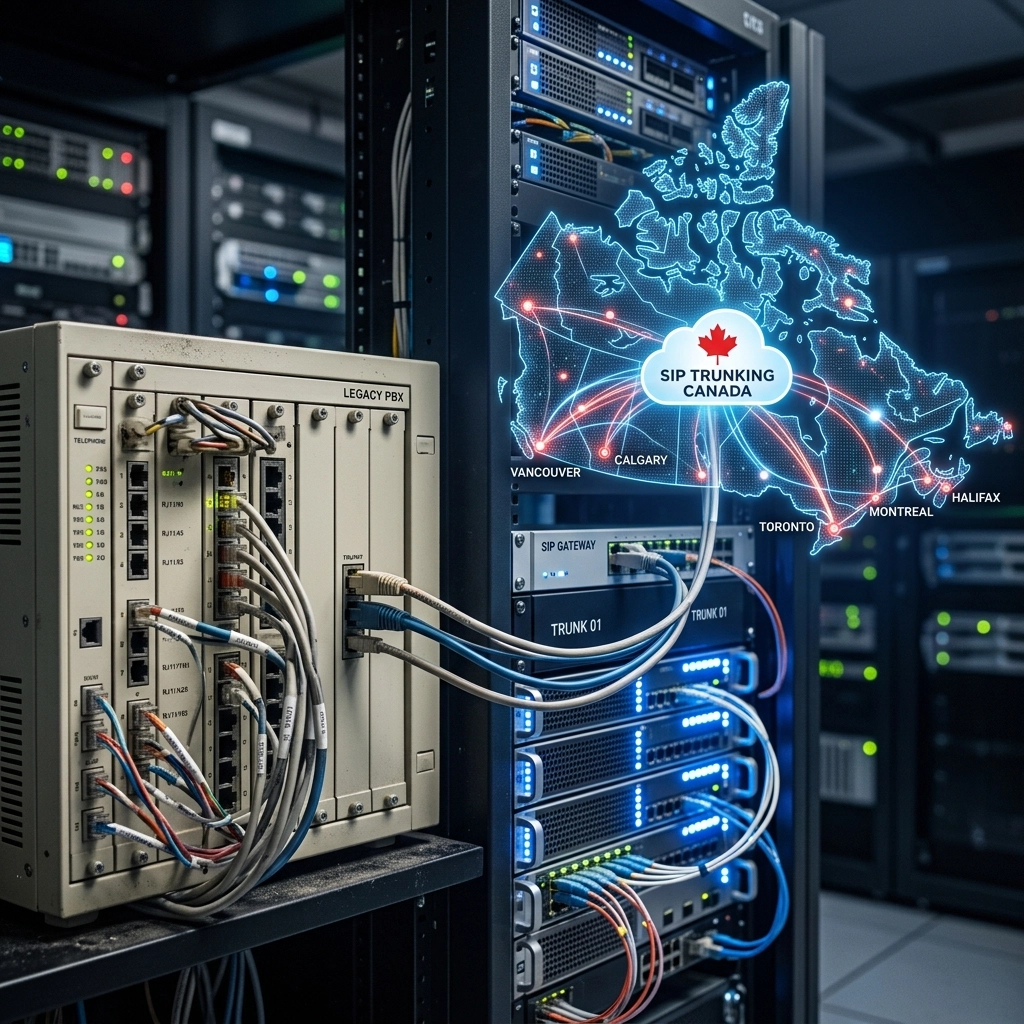
SIP trunking replaces these physical connections with a virtual link over your internet connection. It connects your on-premise PBX (Private Branch Exchange) or your cloud PBX Canada system directly to the Public Switched Telephone Network (PSTN). By removing the physical copper "trunk," you eliminate the hardware limitations that have tethered businesses to their desks for years.

2. Expect Significant Cost Savings
Let’s talk numbers. One of the primary drivers for switching to SIP trunking is the bottom line. Traditional Canadian telcos often charge a premium for physical lines, with costs frequently exceeding $60 to $100 per line when factoring in long-distance and maintenance.
By switching to a SIP-based model, Canadian businesses typically see a reduction in per-call costs of up to 40%. In the current 2026 market, a standard SIP channel in Canada ranges between CAD $15 and $25 per month. If your business handles high volumes of calls, the savings on long-distance alone can pay for the upgrade within a few months. Check out our shop to see how modern hardware complements these savings.
3. Verify STIR/SHAKEN Compliance Is Non-Negotiable
If you’ve noticed a "Likely Spam" tag on your phone when customers call you, it might be because your provider isn't compliant with CRTC regulations. Since November 2021, the CRTC has mandated the STIR/SHAKEN framework to combat caller ID spoofing and robocalls.
When looking for a provider in Canada, you must verify they are fully compliant. Non-compliant trunks risk having their outbound calls blocked by major carriers like Bell, Rogers, or Telus. At Voiswitch, we prioritize security and compliance to ensure your business identity remains protected. You can learn more about how we handle emergency and regulatory requirements on our 911 explained page.
4. Evaluate Network Infrastructure Quality (Tier-1 Matters)
Not all SIP trunks are created equal. The market is flooded with "resellers" who lease capacity from larger carriers. While their prices might look attractive, every extra "hop" your voice data takes adds latency.
High-quality providers operate on Tier-1 infrastructure. This means they own or have direct access to the routing paths, keeping latency below 50ms in major Canadian hubs like Toronto, Montreal, and Vancouver. If your voice data has to travel from Calgary to a server in Virginia and back just to reach a customer in Edmonton, you will experience lag and "echo" effects. Always ask where the provider’s media gateways are located.
5. Check Your Bandwidth and Connection Stability
Since SIP trunking relies on your internet connection, your bandwidth is the foundation of your call quality. Each concurrent call requires approximately 100 kbps for high-quality audio (G.711 codec).
However, it’s not just about speed; it’s about "jitter" and "latency." A high-speed connection that is unstable will result in dropped words and robotic voices. For businesses scaling their operations, we often recommend looking into business internet solutions that offer Quality of Service (QoS) settings to prioritize voice traffic over standard web browsing.

6. Assess Local Coverage and DID Portability
Can you keep your phone number? This is the most common question we get. In Canada, "porting" your number is generally a straightforward process, but coverage varies by provider.
Some global providers struggle with specific Canadian area codes. For instance, while they might offer numbers in Toronto (416), they might lack local presence in more specialized regions or newer overlays like 905 or 403. Before committing, ensure the provider can support your existing Direct Inward Dial (DID) numbers and offer new local numbers in every province where you do business.
7. Plan for Hybrid Work and Scalability
The beauty of SIP trunking is its elasticity. In the old days, if you hired ten new employees, you had to call the phone company and wait weeks for new lines to be installed. With a digital setup, you can add or remove "channels" (call paths) in minutes through a web portal.
This scalability is vital for the modern hybrid workforce. Whether your team is at the head office or working from home in a different province, a SIP-connected system unifies them under one umbrella. For those maintaining a physical office, ensuring your structured cabling services are up to date is essential to support the increased data load of a VoIP-heavy environment.
8. Choose the Right Pricing Model: Channel vs. Metered
Canadian providers typically offer two main pricing structures:
- Channel-Based Pricing: You pay a flat monthly fee (e.g., $20) for a specific number of concurrent call paths. This is ideal for businesses with predictable, high-volume traffic.
- Metered (Pay-As-You-Go): You pay a very low monthly fee per number and then a small rate per minute (often less than a cent). This is perfect for startups or businesses with fluctuating call volumes.
Choosing the wrong model can lead to overpaying. If you have 50 employees who rarely use the phone at the same time, a metered model might save you 30% more than a fixed-channel plan.
9. Hardware Compatibility and Setup Guides
Before upgrading, you need to know if your current hardware is "SIP-ready." Most modern IP-PBX systems are, but older legacy systems may require a "VoIP Gateway": a piece of hardware that converts the digital SIP signal back into an analog or PRI signal the old system can understand.
If you are looking to refresh your hardware entirely, we recommend browsing IP phones from brands like Grandstream. These devices are designed to work seamlessly with SIP trunks, offering features like HD voice and programmable softkeys that older phones simply can't match.

10. Consider Security and Failover Strategies
What happens if your internet goes down? In the legacy world, your phones went dead. In the SIP world, you have options.
A professional SIP provider offers automatic failover. If your primary office connection fails, the system can automatically reroute calls to a secondary internet connection, a mobile app, or a backup cell phone number. This ensures your business stays reachable 24/7. Furthermore, SIP trunks can be integrated with access control systems and other IP-based security measures to create a truly unified business environment.
Final Thoughts: Making the Move
Upgrading to SIP trunking in Canada is no longer a luxury for large enterprises; it is a necessity for any business looking to remain competitive and agile. By moving away from the limitations of copper wire, you gain access to a world of features: from voicemail-to-email to advanced call routing: all while significantly reducing your monthly bills.
If you’re ready to explore how a tailored cloud PBX Canada solution or a robust SIP trunking setup can transform your business, we’re here to help. At Voiswitch, we specialize in making the complex simple. You can read more about our mission to simplify Canadian telecommunications or dive straight into our cloud PBX offerings to find the right fit for your team.
Don't let legacy technology hold your business back. The move to SIP is the last phone system upgrade you'll ever need to make.