If you’ve spent any time looking for a new connection lately, you’ve probably noticed that "Fibre" is the buzzword of the decade. Every one of the business internet providers in Canada seems to have a "Fibre" plan, often at prices that range from $80 a month to $1,200 a month.
This massive price gap leads to a very common question for business owners: What is the difference, and do I actually need the expensive version?
The truth is that not all fibre is created equal. In the world of Canadian telecommunications, there is a massive technical and functional gulf between "Shared Fibre" (often called Broadband or FTTP) and "Dedicated Fibre" (often called DIA or Dedicated Internet Access).
Choosing the wrong one can lead to two scenarios: you either overpay for a massive pipe you don’t use, or you save a few bucks but end up with a "reliable" connection that drops your calls every time the accounting firm next door starts a massive cloud backup.
The Big Difference: Shared vs. Dedicated
To understand why prices vary so much, we have to look at how the data actually travels to your office.
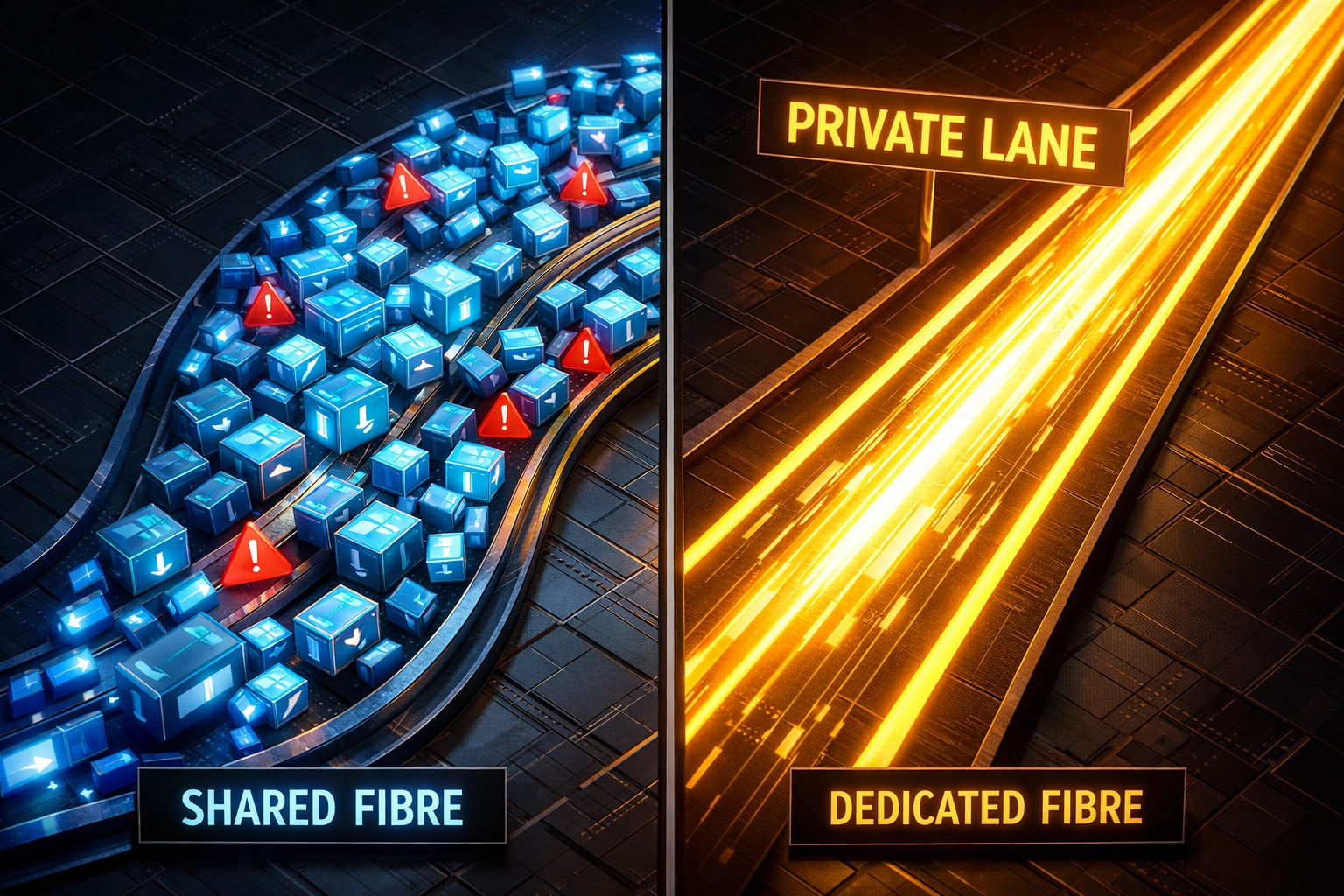
Shared Fibre (The Highway at Rush Hour)
Most "Business Fibre" plans offered by major business internet providers in Canada are shared connections. This is technically known as GPON (Gigabit Passive Optical Network).
Think of it like a highway. You have a very fast speed limit, but you are sharing the lanes with your neighbors. During "rush hour", usually mid-morning or mid-afternoon, everyone is trying to use the same local infrastructure. If the business next door is uploading 50GB of video files, your connection might experience a "bottleneck." You are still using fibre, but the bandwidth isn't exclusively yours.
Dedicated Fibre (The Private Lane)
Dedicated Fibre is a point-to-point connection. It is a literal glass strand that runs from the provider’s data center directly to your building’s server room. You aren’t sharing that "lane" with anyone else.
If you pay for 100 Mbps, you get 100 Mbps 24/7, regardless of what the rest of the city is doing. This is why it’s often called "Dedicated Internet Access." It’s your private pipe, guaranteed.
When Symmetrical Speeds Become a Necessity
One of the most overlooked aspects of choosing between business internet providers in Canada is the "Upload" speed.
Residential and entry-level business plans are usually asymmetrical. You might have 500 Mbps download but only 20 Mbps upload. For a home user watching Netflix, this is fine. For a modern business, it’s a nightmare.
Why does upload speed matter?
- Video Conferencing: High-quality Zoom or Teams calls require consistent upload bandwidth.
- Cloud Backups: If your team is saving large files to SharePoint, Dropbox, or Google Drive, a slow upload speed will make the system feel sluggish.
- VoIP Systems: Voice traffic is sensitive. If your upload is saturated, your voice calls will get choppy or drop entirely.
Dedicated fibre is almost always symmetrical. If you have 1,000 Mbps down, you have 1,000 Mbps up. This ensures that your IP PBX or cloud-hosted phone system works flawlessly, even during peak usage hours.
The Real Value of an SLA (Service Level Agreement)
When you buy a standard shared fibre plan, the provider usually offers "Best Effort" service. This means if the line goes down, they’ll get to it when they can, often within 24 to 48 hours. For a small retail shop, this might be an annoyance. For a law firm or a logistics hub, this is a catastrophe.
Dedicated fibre comes with a legally binding Service Level Agreement (SLA). These agreements typically guarantee:
- Uptime: Usually 99.9% or 99.99% uptime.
- Latency: A guarantee that your data will travel fast enough to avoid "lag."
- Repair Time: A "Mean Time to Repair" (MTTR) that often promises to have you back online within 4 hours.
If your business cannot function without the internet, the SLA is often the primary reason to invest in dedicated fibre. It’s essentially an insurance policy for your productivity.

Is Your Business "High-Stakes" or "Low-Stakes"?
So, do you really need it? Let’s break it down by business type.
You probably NEED Dedicated Fibre if:
- You host your own servers: If you have on-premise servers that external clients or remote employees need to access, you need a dedicated, static, and symmetrical pipe.
- You rely on VoIP for sales: If your revenue depends on clear, uninterrupted voice calls using conference phones or high-end IP phones, any jitter on a shared line is a direct threat to your bottom line.
- You handle massive data transfers: Architects, engineering firms, and video production houses need the symmetrical speeds of dedicated fibre to move files to the cloud.
- Downtime is expensive: If an hour of downtime costs your company $5,000 in lost wages and missed opportunities, the $500 monthly premium for dedicated fibre pays for itself in a single avoided outage.
You are likely FINE with Shared Fibre if:
- You are a small office (under 10 people): If your team mostly uses email, web browsing, and occasional video calls, a high-quality shared fibre plan from reputable business internet providers in Canada will likely suffice.
- Your work is "Async": If you don't do a lot of real-time collaboration or live streaming, you can probably handle the occasional mid-day slowdown.
- Budget is the priority: For startups or non-profits where every dollar counts, a $100 shared plan is a much easier pill to swallow than a $700 dedicated one.

The Cybersecurity Angle
In 2023, Canadian companies spent an estimated $1.2 billion recovering from cybersecurity incidents. While no internet connection is a "magic shield," dedicated fibre offers a layer of security that shared connections don't.
Because the connection is private and point-to-point, it is much harder for bad actors to perform "man-in-the-middle" attacks or intercept data at the local exchange level. When you combine dedicated fibre with high-quality hardware like professional routers, you create a much smaller attack surface for your business.
Scalability: Growing Without Growing Pains
One of the coolest things about dedicated fibre is that the "last mile" (the cable in the ground) is often capable of much higher speeds than you actually pay for.
If you sign up for 100 Mbps today, but your company doubles in size next year, you don't need a technician to come out and dig up the sidewalk. Your provider can usually "turn up" your speed to 500 Mbps or 1 Gbps remotely with a simple phone call.
This flexibility is vital for Canadian businesses looking to adopt emerging technologies like AI tools or extensive IoT devices for access control.
Making the Final Decision
Choosing between business internet providers in Canada shouldn't just be about finding the lowest price on a flyer. It's about auditing your specific needs.
If you are looking to upgrade your office, start by asking yourself these three questions:
- How much does one hour of total internet downtime cost my business?
- Does my team frequently complain about "lag" or "choppy" video during meetings?
- Are we planning to move more of our operations (like our phone system or file storage) to the cloud this year?
If the answer to the first question is "a lot," and the answer to the next two is "yes," then dedicated fibre isn't an expense: it’s an investment in your infrastructure.
At Voiswitch, we help businesses bridge the gap between their internet connection and their communication tools. Whether you need a robust cloud PBX or help understanding structured cabling, we're here to ensure your technology works for you, not against you.

The "truth" about dedicated fibre is that it isn't for everyone. But for the businesses that need it, it is the difference between a frustrating workday and a seamless one. If you’re ready to explore how a more reliable connection can transform your business, check out our business internet solutions today.