For decades, the physical phone closet was a staple of the Canadian office environment. If you walked into any medium-sized business in Toronto or Vancouver ten years ago, you would likely find a heavy, wall-mounted box humming away, connected to a maze of copper wires. This was the On-Premise PBX: the heart of corporate communication.
Today, the landscape of business VoIP Canada has shifted dramatically. With the rise of high-speed fiber optics and the decentralization of the workforce, the "phone closet" is moving to the cloud. However, for many IT managers and business owners, the choice between keeping hardware on-site or moving to a hosted solution isn't always clear-cut.
At Voiswitch, we see businesses grappling with this decision every day. Should you maintain control with a server in your rack, or should you leverage the flexibility of a cloud pbx canada solution? This guide breaks down the technical and financial realities of both options to help you decide which is better for your specific Canadian office setup.
What Is Hosted PBX? (The Cloud Approach)
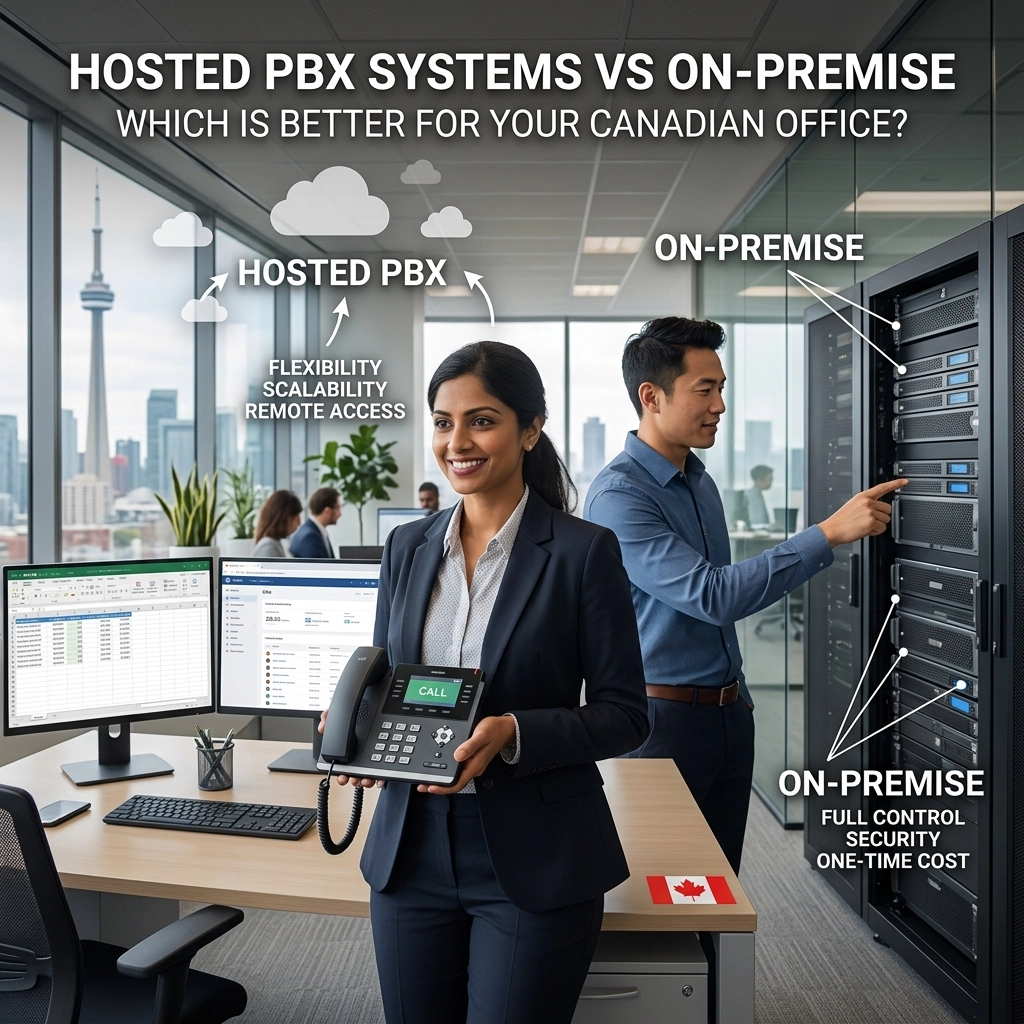
A Hosted PBX, often referred to as a Cloud PBX, is a virtual phone system where the "brain" of the operation lives in a secure, off-site data center managed by your service provider. Instead of connecting your desk phones to a server in your basement, they connect via the internet to your provider’s infrastructure.
For the modern Canadian business, this model follows the "Software as a Service" (SaaS) trend. You don't own the software or the server; you pay a monthly subscription to use it. This eliminates the need for complex internal maintenance and allows for features like mobile app integration and remote work capabilities to function natively.

What Is On-Premise PBX? (The Hardware Approach)
An On-Premise PBX is a physical server or appliance located directly within your office. This system uses your local area network (LAN) to connect phones. To connect to the outside world, it uses either traditional primary rate interface (PRI) lines or modern sip trunking canada services.
In this scenario, your IT team (or a specialized contractor) is responsible for the hardware. You own the equipment, you control the updates, and you manage the security configurations. It is the traditional way of doing business, updated with IP capabilities.
Comparing the Costs: Capital vs. Operational Expenses
One of the most significant factors in this debate is how you prefer to spend your budget.
The Hosted Model: Low Upfront, Monthly Predictability
Hosted systems are defined by low entry barriers. For a small Canadian office of 10 users, you might spend roughly $170 to $250 per month for a professional-grade service. There is almost no upfront cost other than purchasing the IP phones themselves. This makes it an Operational Expense (OpEx), which is often easier for small to mid-sized businesses to manage.
The On-Premise Model: High Upfront, Long-Term Ownership
On-premise systems require a significant Capital Expenditure (CapEx). You have to buy the server, the licenses, and often pay for a professional installation. A system for the same 10 users could cost between $3,000 and $5,000 upfront. However, once that equipment is paid off, your monthly costs drop significantly, as you only pay for your dial tone (SIP trunks) rather than a per-user fee.
If your business plans to stay at the same headcount for 5 to 10 years, the On-Premise model can actually be cheaper in the long run. However, for most growing companies, the agility of the hosted model outweighs the long-term savings.
Scalability and Growth: Which System Moves Faster?
In a post-pandemic economy, Canadian businesses need to be able to scale up or down at a moment's notice.
- Hosted PBX Scalability: Adding a new employee is as simple as clicking a button in a web portal and plugging in a phone. Whether that employee is in your Calgary office or working from a home in Halifax, they are part of the same system instantly.
- On-Premise Scalability: If you reach the limit of your physical server’s capacity, you may need to purchase additional cards, licenses, or even a new server entirely. Furthermore, extending an On-Premise system to remote workers often requires complex VPN setups or specialized structured cabling services to ensure call quality and security.

Maintenance and the "Headache" Factor
Who do you want to call when the phones go down?
With an On-Premise system, the responsibility lies with you. If a power surge fries your PBX motherboard during a winter storm, your business is offline until a technician arrives with a replacement part. You are responsible for software patches, security updates, and hardware refreshes every few years.
With cloud pbx canada, the provider handles the "heavy lifting." Security updates happen automatically in the background. If your office loses power or internet, calls can be automatically routed to mobile phones or other branches because the "brain" of the system is still running in a secure data center. For many Canadian business owners, removing this technical liability is the primary reason for switching.
Reliability and Performance
A common concern with business VoIP Canada is call quality. Because Hosted PBX relies entirely on your internet connection, your office network must be up to the task.
If you have poor internet connectivity and no budget to upgrade it, an On-Premise system using local lines might actually be more reliable for internal calls. However, for most modern offices, a Hosted PBX paired with a professional networking setup provides "crystal clear" quality that rivals traditional landlines. You can learn more about achieving this in our guide to mastering crystal clear call quality.
The Role of Structured Cabling
Whether you choose Hosted or On-Premise, your physical infrastructure: the wires in your walls: plays a massive role.
On-Premise systems often require more complex cabling to connect the central server to every desk. Hosted systems are more flexible but still require a high-quality Category 6 (Cat6) data network to prevent dropped calls and "jitter." If you are moving into a new office, investing in professional structured cabling services is the foundation of any successful VoIP deployment.

Feature Comparison: What Are You Getting?
Modern Hosted PBX systems come "feature-complete." Features that used to be expensive add-ons for On-Premise systems are now standard in the cloud:
- Auto-Attendants (IVR): "Press 1 for Sales" is standard.
- Voicemail to Email: Receive your messages as audio files in your inbox.
- CRM Integration: See customer details on your screen before you pick up the phone. You can explore how to integrate your CRM here.
- Mobile Apps: Your office extension travels with you on your smartphone.
On-Premise systems can do all of these things, but they often require extra modules, specialized configuration, and more expensive hardware.
Which Is Better For Your Canadian Office?
To help you make the final call, consider these three common scenarios:
Scenario A: The Lean Startup or SMB
If you are a growing team of 5 to 30 people, Hosted PBX is almost always the winner. The low upfront cost, lack of maintenance, and ability to support remote workers make it the most logical choice for the modern Canadian business.
Scenario B: The Large Enterprise with In-House IT
If you have 200+ users in a single location and a full-time IT department, On-Premise PBX might be worth the investment. It allows for deep customization and can offer a better ROI over a 10-year period. However, even large enterprises are increasingly moving toward enterprise cloud solutions for the sake of disaster recovery.
Scenario C: The Multi-Location Business
If you have offices in Vancouver, Toronto, and Montreal, Hosted PBX is the clear choice. It unites all locations under one system, allowing for free inter-office calling and a unified "company-wide" directory without the need for expensive networking hardware at every site.
Final Thoughts
The choice between Hosted PBX and On-Premise isn't just about technology: it’s about your business's philosophy toward growth and management. If you value control and have the technical staff to support it, On-Premise remains a powerful tool. But for the vast majority of Canadian offices looking to reduce "headaches" and increase flexibility, the cloud is the future.
If you are still unsure which path is right for your specific office layout or existing hardware, check out our comparison of IP PBX hardware options or reach out to a professional who can assess your current networking infrastructure. Your phone system should be an asset that grows with you, not a liability that keeps you tied to a closet.