For decades, the standard for any professional Canadian office was a bulky, beige box humming in a dark server closet. This was the Private Branch Exchange (PBX): the heart of the company’s communication. But as we move deeper into 2026, the landscape of business VoIP Canada has shifted dramatically. The "beige box" has either moved to the cloud or evolved into a sophisticated IP-based powerhouse.
If you are currently evaluating your communication infrastructure, you are likely facing a critical fork in the road: Do you keep your hardware on-site (On-Premise), or do you outsource the brains of your phone system to the internet (Cloud)?
Choosing the wrong path can lead to unnecessary expenses, technical bottlenecks, and a frustrated workforce. This guide breaks down the "Problem vs. Solution" of modern IP PBX systems to help you make an informed choice for your Canadian business.
What is an IP PBX and Why Does It Matter Now?
An IP PBX (Internet Protocol Private Branch Exchange) is a business phone system that routes calls over IP data networks. Unlike traditional systems that rely on physical copper wires, an IP PBX converts voice into data packets. This allows for modern features like voicemail-to-email, video conferencing, and mobile integration.
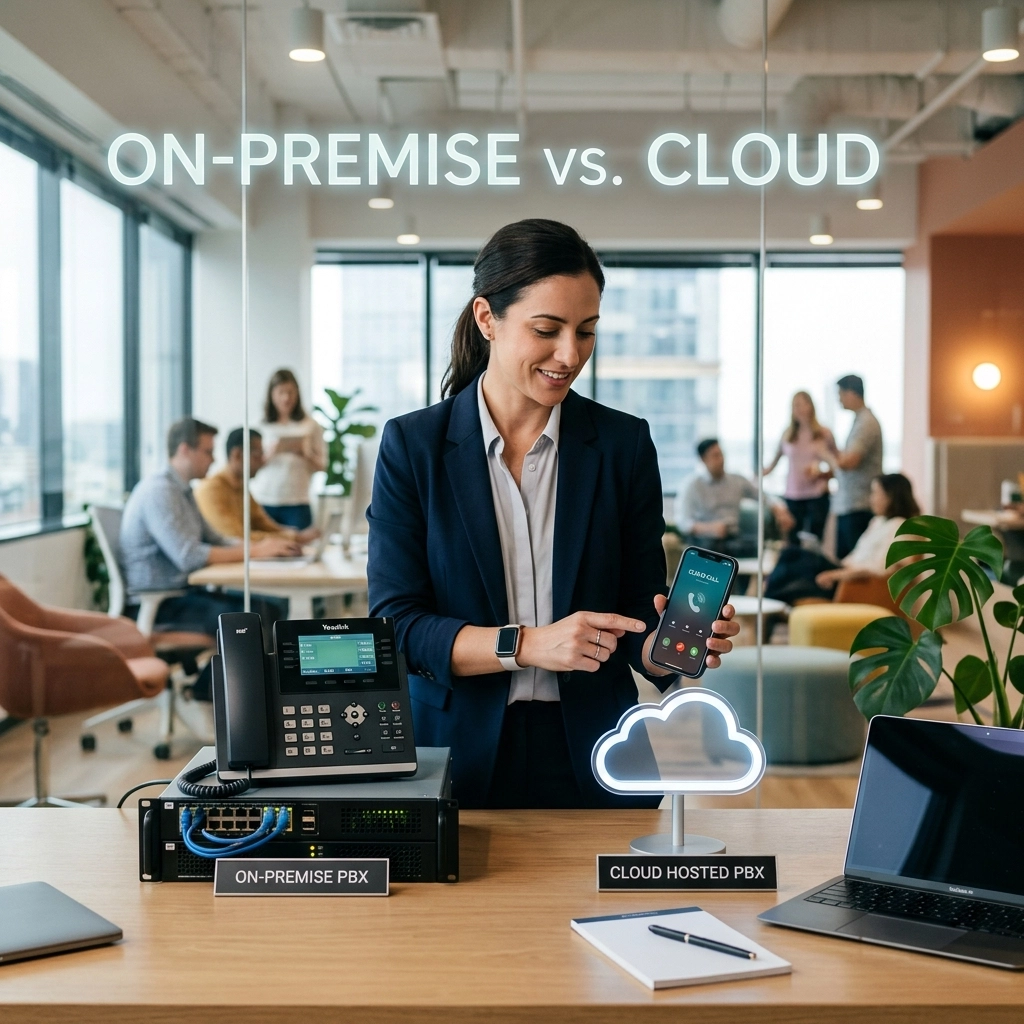
The choice between On-Premise and Cloud is essentially a choice between ownership and service.
- On-Premise IP PBX: You own the hardware. It sits in your office, and your IT team (or a partner like Voiswitch) manages it.
- Cloud PBX: The system is hosted in a secure, remote data center. You "rent" the service on a per-user basis.
For a deeper dive into the basics of these technologies, check out our Business VoIP Canada 101 guide.

Cost Comparison: CapEx vs. OpEx
The most immediate difference between these two solutions is how they impact your bottom line.
On-Premise: The Capital Investment
An On-Premise system is a Capital Expenditure (CapEx). You pay a significant amount upfront for the server, licensing, and installation.
- Pros: Once paid for, your monthly costs are significantly lower (only paying for your SIP trunks). Over a 7-to-10-year lifecycle, On-Premise can often be cheaper for large, stable enterprises.
- Cons: High barrier to entry. You are also responsible for the costs of hardware refreshes and emergency repairs.
Cloud PBX: The Subscription Model
Cloud PBX operates on an Operational Expenditure (OpEx) model. You pay a predictable monthly fee per user.
- Pros: Low upfront cost. No need to buy expensive servers. You only pay for what you use, making it easy to budget.
- Cons: Over many years, the cumulative subscription fees for a massive workforce might exceed the cost of owning hardware.
For businesses looking to scale without a massive initial investment, cloud pbx canada solutions are usually the winner. However, for organizations with existing hardware looking to transition slowly, SIP trunking offers a middle ground.
Scalability and Deployment: How Fast Can You Grow?
In the fast-paced Canadian market, the ability to pivot is essential.
Cloud Scalability
Cloud systems offer near-instant scalability. If you hire ten new employees tomorrow, you simply log into a dashboard, add ten licenses, and plug in their IP phones. There is no physical infrastructure to worry about.
On-Premise Scalability
On-Premise systems are limited by the physical capacity of the hardware. If you reach the limit of your server’s processing power or the number of available ports, you have to purchase new cards or an entirely new server. This often requires professional structured cabling services to ensure the new hardware integrates correctly with your existing network.

Reliability and Uptime: What Happens When the Internet Goes Down?
One of the most common concerns for Canadian business owners is reliability.
Cloud PBX providers utilize geo-redundant data centers. If one data center goes offline, another takes over instantly. However, because the system lives on the internet, your office’s connectivity is a single point of failure. If your office internet goes down, your desk phones stop working (though calls can usually be diverted to mobile apps).
On-Premise PBX systems offer a different kind of reliability. If your internet goes down, your team can still call each other internally across the Local Area Network (LAN). If you have traditional phone lines connected as a backup, you can even make external calls. The downside? If the power goes out in your building and you don't have a backup generator, your entire phone system dies with it.
Maintenance and Security
Who is going to fix the system when it breaks?
- Cloud PBX: The provider handles everything. Updates, security patches, and feature rollouts happen automatically in the background. This is ideal for companies without a dedicated IT department.
- On-Premise PBX: Your team is in the driver's seat. You have total control over your security protocols and data sovereignty. This is often a requirement for legal or medical firms in Canada that must adhere to strict data privacy regulations. However, it requires a high level of expertise to keep the system secure from "vishing" (voice phishing) and toll fraud.
If you are managing a large-scale operation, you might find our guide on enterprise phone systems for large Canadian offices helpful in navigating these security complexities.
Support for the Hybrid Workforce
By 2026, the "hybrid" office is no longer a trend: it is the standard. Your employees are working from home in the GTA, coffee shops in Montreal, and the head office in Vancouver.
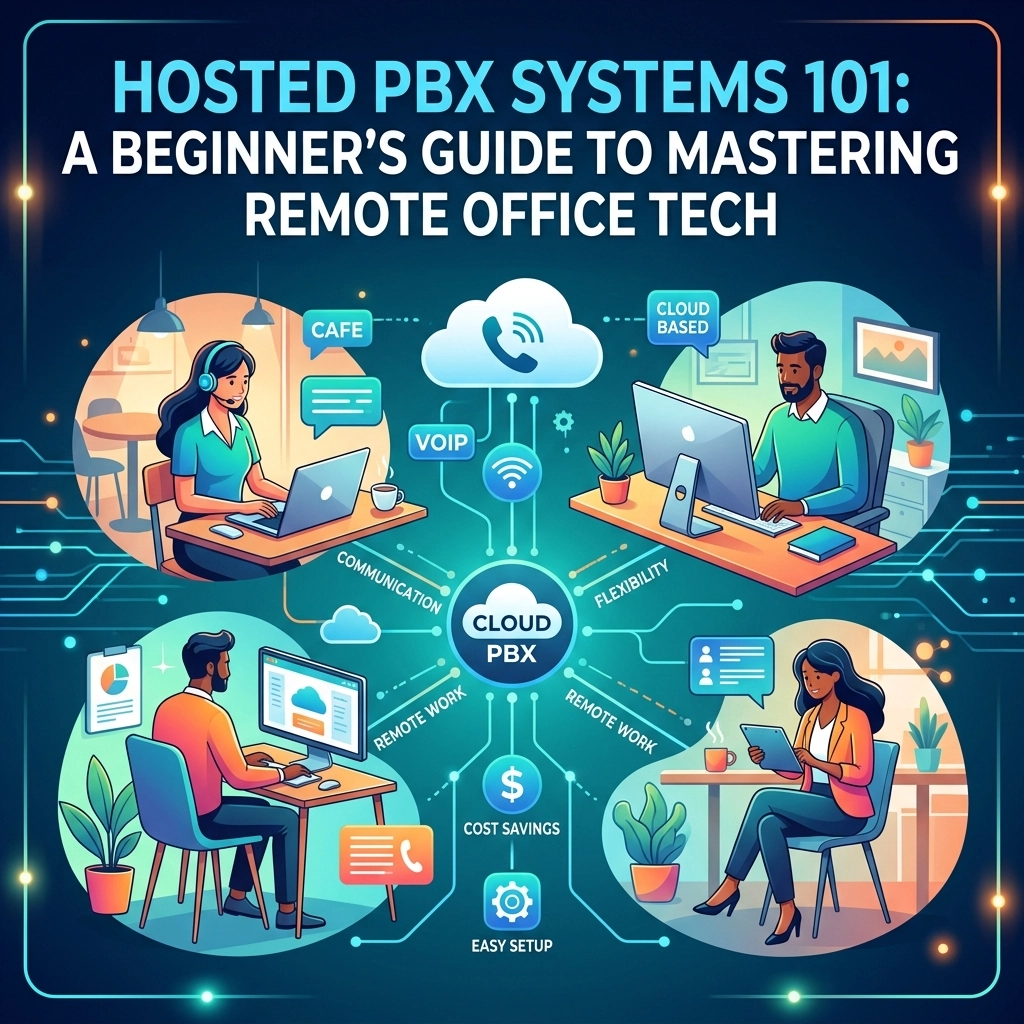
Cloud PBX is natively built for this. A remote worker simply takes their video phone home, plugs it into their router, and it works exactly as it did in the office.
On-Premise systems can support remote work, but it is often "clunky." It usually involves setting up complex VPNs or opening specific ports on your firewall, which can create security vulnerabilities if not handled by professionals.

The AI Factor: The 2026 Advantage
We cannot talk about IP PBX in 2026 without mentioning Artificial Intelligence. Modern Cloud PBX solutions now offer built-in AI features that were once reserved for massive call centers:
- Real-time Transcription: Automatically log every word of a client call into your CRM.
- Sentiment Analysis: Alert managers if a call is taking a negative turn.
- AI Routing: Route callers based on the intent of their voice rather than just "press 1 for sales."
On-Premise systems are beginning to integrate these features, but they often require expensive hardware upgrades or third-party plugins.
Decision Matrix: Which One Should You Choose?
To simplify your decision, use the following framework:
Choose Cloud PBX If:
- You have a distributed or remote workforce.
- You want a predictable monthly OpEx cost.
- You don't have an in-house IT team to manage hardware.
- You need to scale up or down quickly.
- You want the latest AI and collaboration features without manual updates.
Choose On-Premise IP PBX If:
- You have a large, static workforce (500+ users) in a single location.
- You have strict regulatory requirements regarding data sovereignty.
- Your local internet connection is unreliable, but you need internal desk-to-desk calling.
- You already have a significant investment in professional networking infrastructure.

Final Thoughts: Moving Toward a Seamless Office
The debate between On-Premise and Cloud isn't about which technology is "better" in a vacuum; it’s about which one aligns with your business goals for the next five years.
At Voiswitch, we see many Canadian businesses moving toward the cloud for its sheer flexibility and reduced maintenance headaches. However, we also recognize that for certain high-security or high-volume environments, a robust on-premise system: supported by expert structured cabling services: remains a powerful choice.
The "beige box" might be gone, but the need for crystal-clear, reliable communication is stronger than ever. Whether you choose the agility of the cloud or the control of on-premise hardware, ensure your partner understands the unique demands of the Canadian telecommunications landscape.
If you’re still unsure which path is right for your scaling corporation, take a look at our comparison on Enterprise Phone Systems vs. Cloud PBX. Decisions made today will define how your team connects tomorrow.