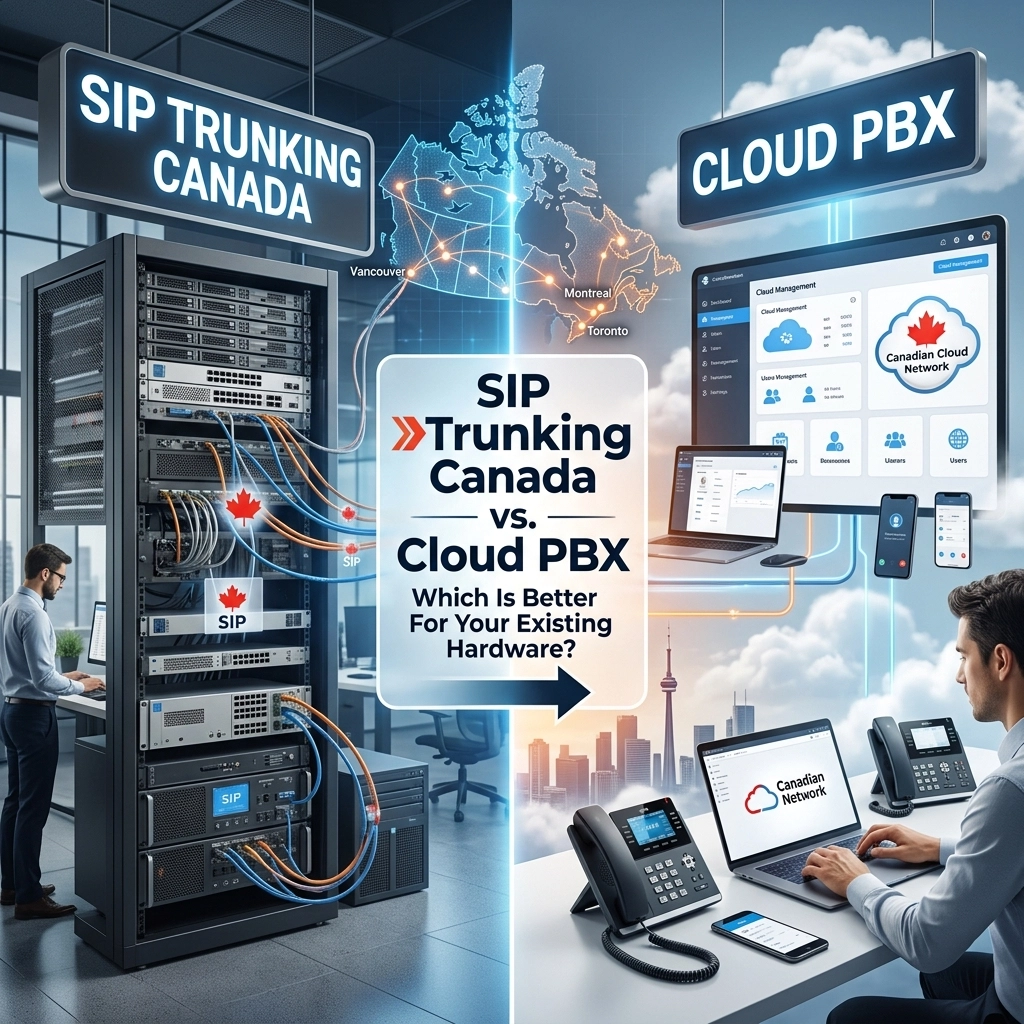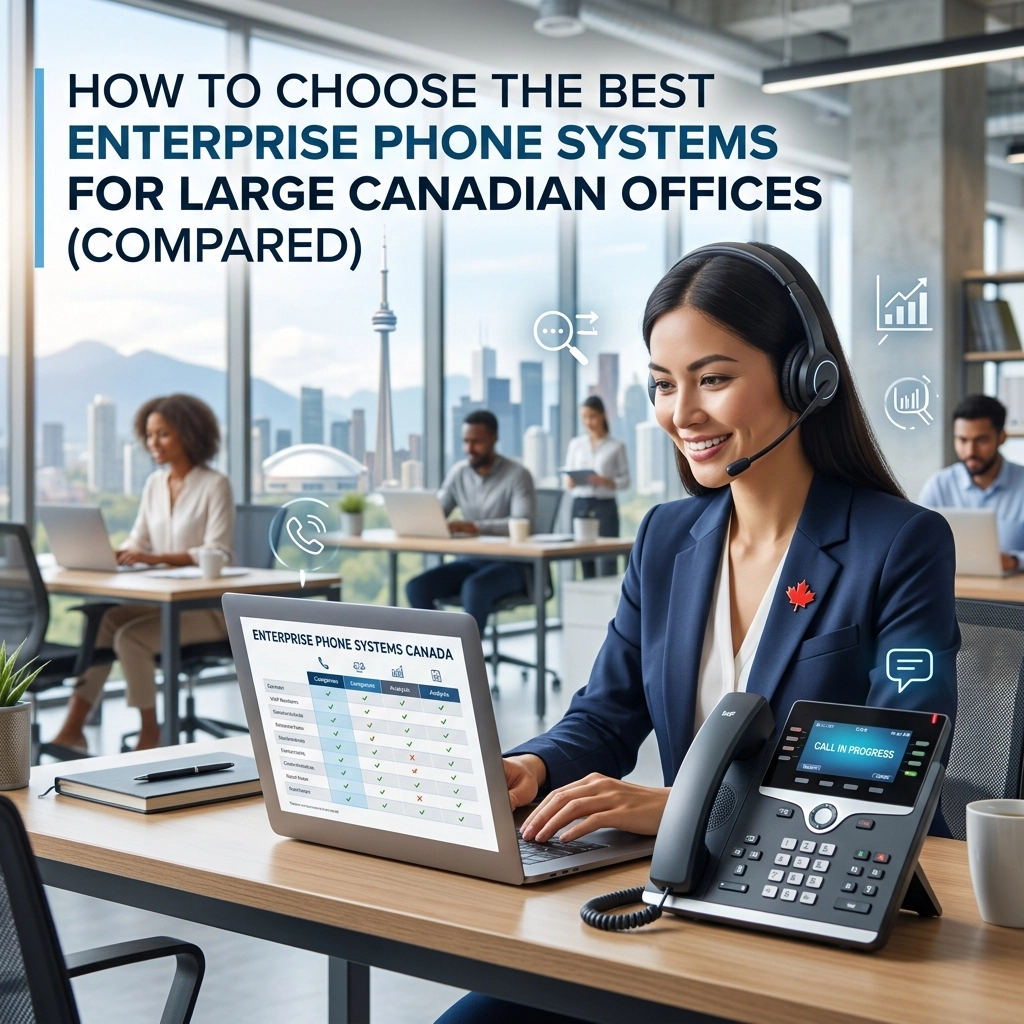
For large Canadian offices, the days of relying on a dusty hardware closet filled with tangled copper wires and expensive PBX cabinets are effectively over. As businesses across Toronto, Vancouver, and Montreal scale, the demand for flexible, high-capacity communication tools has skyrocketed. Choosing an enterprise phone system is no longer just about "making calls": it is about integrating your entire workflow into a single, reliable ecosystem.
However, the transition from legacy systems to modern solutions often feels overwhelming. With a sea of providers claiming to be the best, how do you distinguish between a basic service and a true enterprise-grade platform? In this guide, we will break down the essential factors for selecting a system that supports your growth while maintaining the professional standards expected in the Canadian market.
The Problem: Why Legacy Systems are a Liability
If your office is still running on a traditional on-premise PBX, you are likely facing three major hurdles: high maintenance costs, lack of scalability, and geographical limitations. Traditional systems require physical intervention every time you want to add a new employee or move a desk. For a large enterprise, this translates to thousands of dollars in technician fees and significant downtime.
Furthermore, traditional lines lack the redundancy required for modern business continuity. If a local line goes down, your office goes dark. In contrast, cloud PBX Canada solutions offer geographic redundancy, ensuring that your communication remains active even if one data center experiences an issue.
Key Selection Factors for Canadian Enterprises
When evaluating enterprise phone systems, you need to look beyond the price tag. For large-scale operations, the "hidden" features often determine the long-term success of the deployment.
1. Call Management and Complexity
A large office isn't just one department; it's a collection of sales teams, support desks, and executive suites. Your system must handle high call volumes with ease. Look for:
- Multi-level Auto-Attendants: Directing callers to the right department without human intervention.
- Hunt Groups: Ensuring calls are distributed fairly or sequentially among team members.
- Visual Voicemail-to-Email: Streamlining how messages are managed across the organization.
2. Integration Capabilities
An enterprise phone system should not live in a silo. It needs to "talk" to your CRM (like Salesforce or HubSpot), your email suite (Microsoft 365 or Google Workspace), and your internal messaging tools. This integration reduces "app fatigue" and allows your employees to trigger calls directly from their browser or customer records.
3. Reliability and Compliance
In Canada, compliance is non-negotiable. This includes adherence to PIPEDA for data privacy and ensuring your 911-explained protocols are correctly configured for multi-line systems. Large offices must ensure that emergency services can pinpoint the exact floor or suite of a caller, a feature often overlooked in basic VoIP setups.

Comparing the Top Enterprise Contenders
To help you make an informed decision, let’s look at how the leading players in the Canadian market stack up against one another.
RingCentral Ultra
RingCentral is often cited as the gold standard for feature-rich enterprise communication. It offers a massive array of integrations and highly polished apps for mobile and desktop.
- Best For: Organizations that need every possible bell and whistle and have the budget to support it.
- Pros: Industry-leading CRM integrations, 24/7 support, and robust analytics.
- Cons: Higher price point and can be overly complex for teams that just need reliable voice.
8×8 Work
8×8 is the go-to for Canadian enterprises with a heavy international presence. Their platform is built for global reach, offering unlimited calling to dozens of countries on their higher-tier plans.
- Best For: Global enterprises and international sales teams.
- Pros: Strong international calling packages and advanced speech analytics.
- Cons: The user interface can feel a bit dated compared to newer entrants.
The Big Three (Rogers, Bell, Telus)
The traditional Canadian telcos offer unified communications bundles that often combine your office internet, mobile plans, and phone systems.
- Best For: Companies that prefer a single bill for all utility services.
- Pros: Deep infrastructure within Canada and bundled pricing.
- Cons: Support can be slow, and their cloud platforms are often white-labeled versions of third-party software rather than proprietary, innovative tech.
Voiswitch Cloud PBX
Voiswitch provides a tailored cloud PBX experience specifically designed for the Canadian business landscape. Unlike massive global corporations where you are just a ticket number, Voiswitch focuses on high-touch support and custom configurations.
- Best For: Large Canadian offices that need a professional, reliable, and scalable business voip canada solution without the "big telco" headaches.
- Pros: Local Canadian expertise, competitive pricing, and seamless integration with hardware.

The Infrastructure Foundation: Don't Forget the Wiring
Choosing the right software is only half the battle. A high-end enterprise phone system will only perform as well as the network it runs on. For large offices, this means investing in high-quality structured cabling services.
If your office wiring is ten years old, you may experience "jitter" or dropped calls, regardless of how good your VoIP provider is. Enterprise-grade VoIP requires a stable, low-latency connection. This is why many businesses choose to upgrade their structured cabling alongside their phone system. Proper Category 6 (Cat6) or fiber cabling ensures that your voice data is prioritized and protected from interference.
Hardware: IP Phones and Beyond
While many employees now use "softphones" (apps on their computers or mobiles), most large Canadian offices still require physical desk phones for reception, boardrooms, and executive offices.
- IP PBX Systems: For companies that require on-premise control with cloud flexibility.
- SIP Trunks: If you already have a modern PBX but need a more cost-effective way to connect to the public telephone network, SIP trunks are the answer.
- Conferencing Tools: Large offices need high-fidelity hardware for boardrooms to ensure remote participants are heard clearly.
You can explore a range of compatible hardware at the Voiswitch Shop to see what fits your aesthetic and functional needs.

Cost-Benefit Analysis: The Bottom Line
When presenting a new phone system to stakeholders, focus on the Total Cost of Ownership (TCO). A legacy system might seem "free" because it’s already paid for, but the costs of analog lines, long-distance charges, and missed opportunities due to lack of features add up quickly.
Modern cloud PBX canada systems typically operate on a per-user, per-month model. This moves your telecommunications from a Capital Expenditure (CapEx) to an Operational Expenditure (OpEx), which is often much friendlier for corporate budgeting. You stop paying for "capacity" you don't use and start paying for the actual seats you need.
Security and Privacy in the Enterprise
Large offices are frequent targets for social engineering and toll fraud. When selecting a provider, ask about their security protocols.
- Encryption: Is your voice data encrypted in transit?
- Multi-Factor Authentication (MFA): Is your admin portal protected against unauthorized access?
- Physical Security: Are the data centers located in secure facilities with redundant power?
Voiswitch takes these concerns seriously, ensuring that your communication remains private and secure. You can review our commitment to data in our privacy policy.

Final Recommendation: How to Decide
Choosing the best enterprise phone system for your Canadian office comes down to a few final questions:
- Does the provider understand the Canadian market? (E911 regulations, local porting, Canadian data residency).
- Can the system grow with us? (Adding 50 users should be a few clicks, not a week-long project).
- Is the support local? (When things go wrong at 9:00 AM EST, you don't want to wait for a support center in a different time zone to wake up).
If you are looking for a partner that combines the power of enterprise-grade features with the personalized service of a Canadian specialist, Voiswitch is here to help. From business internet that powers your calls to the access control and security cameras that protect your physical office, we provide a holistic approach to telecommunications.
Ready to upgrade your office communication? Contact us today for a consultation tailored to your large-scale requirements. Or, if you have more questions, check out our FAQ for quick answers on how we can transform your business connectivity.